Christine McIver—From Best-Kept Secret to Trusted Authority and Scalable Business

Why do so many experienced entrepreneurs stay invisible when they know their craft better than anyone else in their market?
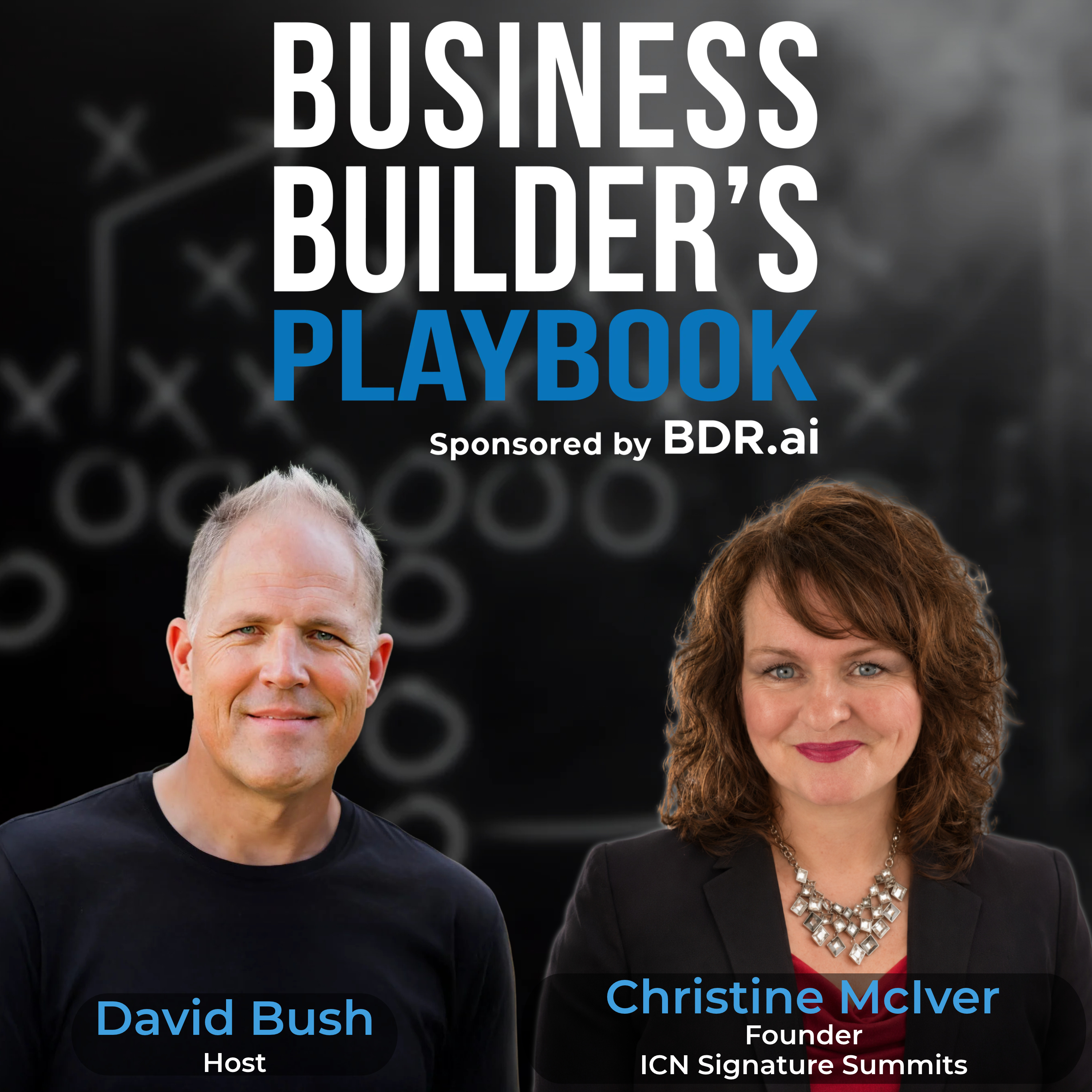
In this episode of the Business Builder's Playbook, host David Bush sits down with Christine McIver, founder of ICN Signature Summits. Christine has produced thousands of episodes of live shows, podcasts, and summits, and she has spent her career helping experts see the value they carry. She explains why so many of them hold back and what to do about it.
David adds his own playbook for finding the right people, following up without feeling like a pest, and building a 90-day plan that produces qualified conversations.
Here's what you'll learn by watching or listening to this full episode:
-
How to list the education, courses, books, and money you've invested in your expertise so you can walk into every conversation with real confidence.
-
How to ask yourself, "Is that still true for me?" to question the fears, doubts, and old beliefs that came from someone else's voice.
-
Why copying what successful people do pulls you away from your own expertise, and how to find the core thread that connects everything you do.
-
How to ask better questions and talk less about yourself so prospects feel heard before you ever pitch.
-
Why asking for support, reviews, and sales gets results that waiting never will, and what Christine learned from running her 100-day Up Your Ask program.
-
How to build your prospect list from the hottest relationships outward, starting with the contacts already in your phone.
-
Why great content reaches only 1 to 3 percent of your followers, and how to combine warm outreach, free content, and cold outreach to reach the rest.
-
How to build content around your audience's pains and problems first, since people move away from pain faster than they move toward pleasure.
-
How to follow up with professional persistence, since most business-to-business sales take about 15 touches.
-
How to set a 90-day plan that starts with a clear outcome, an honest starting point, and a calendar that matches your goal.
Christine McIver 0:00
If you can't say, if you can't look in the mirror, David, and say, "I know what I'm doing, and I know I have value to bring to the table with confidence," then that's where you need to work. You need to go inside. You need to do that internal work, because until you do, nobody is going to connect. They're just not.
David Bush 0:20
Welcome to the Business Builders Playbook, the show that breaks down the systems and strategies behind predictable revenue growth to win in business. In each episode, we're diving into the proven strategies that separate the winners who scale from the losers who fail. This show is sponsored by BDR AI, the AI-powered business development platform that automates your outbound prospecting, so you can focus in on closing deals instead of chasing leads. Let's get started. All right, well, welcome everybody. So excited that you are here today. Whether you're watching this live or you're watching this as a recording, we are so excited to have you join us today. We're going to be talking about a very important topic, and that's why you took the time to watch this. And I just like to ask for your undivided attention for the next 60 minutes, because what you're going to hear in the next hour can be absolutely game-changing for your opportunities in the future. I've got an expert. I've got somebody that has absolutely mastered the topic of moving from being a best-kept secret to a trusted advisor, a trusted authority factor, and building a scalable business. Christine and I have known each other. Gosh, it seems like it's been a couple years now, and I have been so enamored by the way that she organizes and puts people into position to absolutely crush it when it comes down to crafting credibility and trust and authority and being able to create a duplicatable system. And so that was my reason for wanting to have this conversation with you, Christine, is that I wanted to share your brilliance with everybody else because I think that the things that you teach and the things that you give to people in terms of tools and tactics and strategy are just absolutely extraordinary. So thanks for taking the time out of your busy day.
Christine McIver 2:09
Thank you, David. I was thrilled when you said I would like to do this with you, and I'm like, yes. Why would I not say yes, David? You're brilliant in what you do, and your brain. I love watching your brain, and I love when you explain things to me. Even though I go glassy-eyed, I'm really enamored with what you teach me.
David Bush 2:29
And I thought I was doing so well when those glassy eyes came up, but I'm I'm glad that you're taking something away from here, and I'm glad that all of you are here. And all of the questions that you submitted, man, they're so good, and I think we're going to answer the majority of them. But if your question did not get answered, please know that Christine has offered to follow up with every person that took the time to register and submitted a question. And if you are watching this on social media as a replay, and if you comment and ask a question, we respond to every single comment, and so if you have a question you'd like to get answered during the live show, if we have time, we'll get to them in the order in which they're received. So use the Q and A feature to submit that question, or just throw it into the comments so that everybody can see it. And maybe if one of us can't answer it, somebody else with a lot of other expertise. I know we're filled with a bunch of people that have a lot of expertise and experience. Maybe there's some collective wisdom here. I know that Amy is a brilliant person as well. So there's lots of brilliance in the room. So let's go ahead and get started. Christine, tell everybody a little bit about your background and kind of what brings you to where you're at today, talking and executing on this particular topic at a high level.
Christine McIver 3:43
Well, David, I started out. My first career was in human resources, and while that really lit me up for as long as it did, what I came away understanding is that people do not recognize their capacity; they do not recognize the brilliance that they are, and that they are chasing. Everybody's out here chasing, and that hasn't changed in 40 years. Everybody's still chasing, and it's one of the biggest things for me is is when I was in human resources was really being present with that person and getting to know who they were. Well, when I started my own business, I started in personal coaching, and and the same theme was coming through. They didn't know their brilliance. They didn't know which direction to go in, and they were trying to, you know, we're we're out here trying to grab whatever it is that's going to give us what we're desiring. The biggest challenge is they're not sure what they're desiring, and so as I started my business in in the media sector, right, producing shows, producing live shows, podcasts, summits, and the publishing, it it that still rains through. It's the people want to be known. For their expertise, it's in their heart, but they a don't know how to get out here, and b they're looking outside of themselves like I did, looking outside, going, "What should I be doing? What should I be doing? What should I be doing?" And what really laid on my heart was, I want to really show the world the brilliance that I see in someone, and sometimes it takes a while for them to see it in themselves. So how are they going to see it in themselves? How are they going to have other people see it in them? Pardon me, if they don't see it in themselves. So that's what's really brought me to this. Is it? I've I've always been a cheerleader, and you know it continues. And and that's what lights me up, honestly.
David Bush 5:42
Yeah. Well, those things that you just talked about are so crucial to the reason of why you're so successful. Is because people want to be listened to, and they want to be awakened to the expertise and the gifting and the talents that they have. And so many people have kind of got into some head trash, and they are you know overthinking the idea of putting out their work. I don't know if you've ever read the book Steal Like an Artist. No, it's a it's all about the concept of that most artists are all thieves. They've they've basically stolen an idea from somebody else, and it's not that they've stolen creative work; they've just taken a concept, and then it basically is painted out there. And then now there's a whole trilogy series. Austin can't remember Cleon, I think is his name, and he just talks about the idea is that display your art, display display your brilliance, and and so many experts, you know, highly experienced, highly educated people. They think too much about what everybody else is thinking, and not necessarily about the fact that most people don't think that much about us. You know, they're more thinking about their problems, and so they oftentimes, you know, put their light underneath a a damper, and they don't necessarily get to be able to be shining bright like they should. And that oftentimes shows up in the lack of profits, lack of opportunities, stress, lack of peace, lack of freedom. And so we're going to hopefully dig into that and kind of uncover that with the the four A framework, but let's let's talk a little bit more about why do you feel that so many highly experienced entrepreneurs remain relatively unknown? I mean, what is it that's got it? They've got all this information, all this education, all this expertise, but they just don't necessarily have the the limelight or the opportunity to spread that message across a large audience.
Christine McIver 7:46
Well, I think one of the greatest things that we do is we get an idea in our heart. Do you remember when you thought about starting your own business, David? Do you remember that moment when something just jumped up in you and you got so excited? Right. I remember that moment of thinking, "Oh my God, I'm going to do this," and we begin. We take that step forward. We're so excited, and then because we're inexperienced, we start looking at what everybody else is doing, and it's like, "Oh, there's David. I should do what David does. He looks successful. Oh, I should do what Christine does, she looks successful. I should do this, and I should do that. Well, the experts are telling me to do this, and we're out here scrambling to try to capture what it is that will actually elevate us. And we've disconnected from our brilliance. We've disconnected from what's in our heart, and we're not actually present with our expertise, so we're trying to be something that we think will be successful, will be heard, will be seen, but people are losing the connection because if you're showing up with somebody else's brilliance, with somebody else's model, and it doesn't resonate with you, the energy is off. The energy is off. If I came in here and I had a different name, the energy with me would be completely off. You wouldn't connect with me, David. You'd be like, I don't know what the heck's going on with Christine. Like she changed her name. That's not a big, really big deal. But what's off? Because we lose the connection to ourselves. And so when we lose the connection to ourselves and what's on our heart and what we really are an expert about, we lose our confidence. We're not showing up with confidence, so we do not resonate with the truth of our expertise in the world because we are all out here trying to do the right thing, the successful thing, and we're not coming back to being present with who we are, you know. I'm seeing people on social media; they're out here posting constantly, and I come in, you know, maybe twice a day, couple times a day. My mother's trying to say both things, and and I come in and I'm like, wow, they have a lot of time in here, and I'm in my business. I'm over here working in my business. I'm having those conversations with clients. I'm building what needs to be built with my clients. I'm creating. I'm in the laboratory. I'm not out just doing social media and reading everything everybody else is doing, and I'm also spending a lot of time connecting with myself, so I think there's a big disconnect between being seen and connecting with who we are, and I think that's one of the greatest injustices that someone is doing if they want to actually be taken seriously for what they are an expert at. And when you're not confident with who you are, and you don't acknowledge your expertise to yourself. How in the world is somebody else going to?
David Bush 10:48
That's good. I know that for me personally, one of the things that I struggle with is that I feel that feel like everybody already knows what it is that I know, and why should I? And and I really struggle with that because it 20 some odd years ago, a little bit more than 20 years ago. Man, I'm old. I I went through this process of like I wanted to talk about helping people to design an extraordinary life, and I kept thinking to myself, you know, there's already so so many amazing books about this, and I just didn't think that my experience or story was going to be better than the ones that I had already read on the topic. Yeah, so I was basically, you know, putting my my own personal story down and kind of just saying, "Hey, it's not really worthy." And one of the friends of mine, 20 years later, said to me, he goes, you know, David, it's not really in the information; it's in your story and how you apply the information that is the most valuable thing to the people that you tell it to. Because some people are just going to identify with your story, and it's not the principles as much as it was your story and how you applied the principles in your own journey. And I was like,
Christine McIver 12:01
oh, oh. it was one of those aha moments. Yeah,
David Bush 12:04
I wish I would have had that thought 20 years earlier. And that goes back to the idea of why so many people work with you is that you know the experience of others compresses time, and when you work with somebody like Christine, and she can ask you really, really strategic questions, and you answer those questions, which then becomes making you aware, and then she also questions your answers, and she gets you to start thinking about these ideas of like you know in a positive way, but also in a challenging way to start challenging you to start thinking more about what it is that you bring to the world and what your true value is. So you know, a lot of people struggle with the same thing that I struggle with. They inside the jar, they can't read what's on the label. They can only see what's on the inside of the label. Can't they can't see on the outside? So, how do they begin recognizing the true value of their knowledge from what you've seen has worked?
Christine McIver 12:57
Well, one of the biggest things that I will do with a client is I will have them actually list out everything that they have invested in, and I know this seems like a little opposite to what I said earlier, but I get them to literally list out. So, how many years of high school did you have, and did you go to college, and did you go to university? Tell me about how many courses you have taken, how much financial investment have you made, and I will have them go through all this, and then I will say, okay, so tell me how many years have you been in business? On average, how many clients have you had each each time each year? How many how many times have you been out speaking? How many times have you been interviewed? How many times have you stood on the stage? You know, tell me how many books you've read last year, and I get them to list this all out. You said something earlier about everybody is just you know you don't see your value because it's just like something like so easy. Well, because it's not new to you or I what our expertise is, it seems like everybody should know it because it comes easy to us. We think everybody else should know it, right? We think that well, I've read a book about business, so my why would I write a book about business? But the energy that you are and the brilliance that you are is going to be different than any other human being on planet Earth, and it's this is really true, David. In running my platform, so we have live radio shows, right? And nobody, the hosts are not talking to each other like, "Hey, what are you talking about next week on your show?" And more times than I can honestly tell you, they'll submit their show and what they're going to talk about, and the topics are so similar. We would swear that they wrote them together, and they will show up, and they will be speaking about the same concepts. But the energy that they bring to each of their shows and the way they deliver it pulls you in separately. I have produced well over 5000, probably. Closer to 8000 episodes, I listen to people again and again and again, and I hear the same concepts, but the delivery is so different. So you and I could each do a show. We could have a script, David. We can't, you know. You have to read the script exactly, but you got to do it with your energy. People will be attracted to you, David, that would never hear me, and vice versa. We've got to begin to acknowledge the uniqueness of who we are, and we've got to acknowledge that our value. We've got to be acknowledging it again and again. So, taking that time to list all you financially invested in, and all the education, and all the books, and all the audio books. I can't even tell you how many audio books that I have listened to and taken concepts from. When you understand the investment that you have made, you'll start to elevate your confidence, and you'll start to see your expertise in a completely new way. Then you start to show up differently. You start to understand that the evolution of who you are is something that someone is looking for, and you've got to own that before you start to show up anywhere. If you can't say, if you can't look in the mirror, David, and say, "I know what I'm doing, and I know I have value to bring to the table with confidence," then that's where you need to work. You need to go inside. You need to do that internal work because until you do, nobody is going to connect. They're just not.
David Bush 16:31
So if this show is resonating with you and you're ready to take action because you want to scale your business faster, smarter with more AI and technology and less labor, check out BDR AI. We help entrepreneurs and executive sales leaders to automate the grind of prospecting, so you can focus your time on closing deals and growing revenue where you should be spending your time. With AI-powered data, digital outreach automation, and done-for-you prospecting systems, you'll connect with more qualified leads, book more appointments, and build predictable revenue without adding more hours to your week or the week of your staff. Visit BDR today and discover how our AI prospect finder and digital BDR agents can help you to build your pipeline and your profits. Visit BDR AI where business builders learn how to automate and scale their playbook. That's great. It's a great reminder, and you know we all have our our own. I was told I can't remember the exact exact study, but there's a study that's talking about your belief system, and there's these first initial belief systems that are implanted in you. You don't even have any control over them. They're the people that raised you. You know what country you're born in, what city you're born in, right? There's different belief systems, right? People that come from different countries have different belief systems just because of the culture and the upbringing, the experiences that they had. That becomes the implanted belief system, and then this this third level is really the untapped potential, and the third level is the inspired belief system. And what I have found, Christine, is that many of the people that we partner with that are in a position of fear or limiting beliefs or concerns or doubts, they oftentimes have these implanted and imprinted belief systems, and they haven't gone through the inspired belief systems like what you're talking about, and uncovered some of those thought processes. Like Zig Ziglar used to say, you know, if I was to if I was to say, give me your head, give me your brain, how much would you charge for it? You know, like there's a lot of value tied up into that brain, right? There's a lot of things that you think, well, without my brain, I wouldn't be very valuable. Well, how much would you charge somebody for your brain? Well, 10 million, 100 million, right? Well, now you're pretty valuable because now your brain's worth $100 million. So, what are some of the fears and beliefs that you come across that are common? And then maybe what are you doing to help people to overcome some of that past history or drama and trauma that has maybe got them prevented from doing the actions?
Christine McIver 19:12
Well, I think some of the biggest fears are that I'm not going to be successful. I put my neck on the line. I I hung up my you know I hung up my nameplate, and what what if they go into this what if right they go into that space of the future and they're projecting their doubt into the future and they're basing that on they've never done this before so they're like well I've never been successful okay well if you've never run a race how do you know you're going to fail if you run the race. So one of the biggest things that I encourage my clients to do is, if they have a fear that comes up, if they have a belief system that comes up, a doubt that comes up, in the moment in time that they get center with themselves, ask themselves this one question, and this is a question. This. A writer downer. This is a question that we should be asking ourselves on a daily basis. Is that still true for me? You see, we've got so many beliefs and fears and doubts so programmed that they are automatic, right? We look at cake, and what's what do we do? Most people go, oh, I shouldn't eat that because I'm going to put on weight. I'm like, I can't wait to eat that cake. Like, my cake lover, by the way, I can give you my address if you want to send me cake. But we we don't question them. We allow the brain to run the show, and we need to get back to questioning the programming and questioning what is true for you today. So imagine, David, if you said, "I'm not," you know, what I do is not that valuable, and you actually stopped and you went, "Hold on a second, is that really true for me today?" Well, no, because I talked to Christine yesterday, and the conversation went great, and she's interested in doing this with me, so I don't know that that's true anymore. So we need to start questioning what what we are listening to inside our head. We need to start really evaluating the the real that we've got going. We all have a real going, and and we're listening to an old reel, and it's often based on, you know, other people's voices. Like, even if you ask, like, whose voice is that? Oh, that was my dad's voice. Oh, that was my mom's voice, or that was my old boss who didn't like me so much. Whatever, right? But we do not spend nearly enough time getting to know what really is true for us today, and I think when we unpack that, and like you say, I question your answers. I will question them because I want you to question your answers. I want you to get underneath there, and if we could spend more time questioning those things, we would start to uncover that a lot of it isn't true. It's kind of like cleaning out the old garbage, you know. If you ever had a lot of food in the fridge, and it's like, oh, it's time to check the expiry dates. A lot of your beliefs have expiry dates, and it's time to start cleaning that out and start to change that because you deserve to be happy, and wealthy, and successful. There is more money in the universe than anybody could ever count. There's never been more money in the universe today than there was any other day in your lifetime, David. There's plenty, plenty for us, but we actually, by buying into all of the everybody else's thoughts and beliefs, we actually keep it away from us. And I know that when I started to change that, when I started to question that, and I'm not saying that you know who taught us these things were wrong. That's that's where they got to, right? Like our children are going to be smarter than us, and I really do hope that they are. I hope they learn from us and they take they take the baton to the next level. Well, that's what our parents did, but we've got to question if what they believed is true for us today.
David Bush 23:06
Yeah, that's so good. I've heard the quote that says, "You know, the person that controls the definition controls the argument," and you know, some people will hold back from being more of. I actually just saw an interview with Oprah, and she said the gal asked Oprah and said, "You know, what would you have done differently if you had the opportunity?" And she said, "I would have stopped apologizing for being over the top
Speaker 1 23:32
because that
David Bush 23:33
was me." And people would say, "You know, oh, she's over the top. She's all she's full of herself." And she's saying, "I used to apologize and say, 'No, no, no, I'm sorry, no, that's not me.'" But she goes, "That was me. That's who I was, and that's what made me into the success that I was." And so, rather than apologizing and allowing somebody else's negative influence to have influence over me, I just wouldn't have done that. So, there's plenty of people that are watching this video right now that are in a position right now where they're saying, "I know I've got something to share. I've got a lot of expertise, and I'd love to share it, but I'm kind of caught between a split personality. I really love this topic, and I really love that topic, and I could talk a lot about that topic. So, where would you question or challenge somebody to kind of get more lasered in on a specific topic?
Christine McIver 24:27
Well, you know, David, it's funny because I had this struggle. I had all these different things that I was doing in my businesses, and it was probably two years ago when it's you know the puzzle pieces started to connect. And what before they could connect, I had to again go within myself, and I had to find the thread that was through all of these things that I did, because you know, like I could work, and I used to work many, many hours a day, and I like working, and I like my business, I like what I do, so. I could get lost in it for a long, long time, and then there needs to be balance to it, right? But what I found was I needed to find the core thread between all of these businesses, so that when things got difficult, when things got heavy, when there was long hours, you know, when when there was anything challenging happening, that I could touch touch that base. I could go back to that thread on why do I do what I do, and I think for many of us, we can sit here, David. You and I could come up with 15 topics to talk about very, very quickly, right? But there has to be a thread underneath it. At why do I do what I do? What is it about this topic that really speaks to me deeply? We've got to have that core, and everybody has to have that at the core of what moves them forward. And I'm going to be really straightforward. It takes experience. It takes trying things and not succeeding. It takes trying things and going, wow! Nobody really bought into that. Or it takes stepping out and and being scared and doing it to find out what really is true for you, what works and what doesn't work. Until you actually take that step, you're not going to be able to figure out what is the core thread. And so, you know, I've tried on different businesses or different ideas of businesses, and they went so far, and then they stopped. But I learned something. I had a I had a program that I did twice. 100 days I went live with a group. 100 days in a row. Oh man, was I exhausted? But it was called Up Your Ask. So we all talk about. I know
David Bush 26:42
clever, clever,
Christine McIver 26:43
clever. But we all talk about receiving, right? Is one thing that we need to up our receiving. But oftentimes we're talking about do do do, and I think
David Bush 26:54
still we're I'm still talking about up your ass, and now you're talking about do do do. I'm I'm sorry, I'm all over the place now.
Christine McIver 27:00
That's okay, but I got you thinking. But we don't ask, we don't ask ourselves questions. We don't ask for the things that we desire. We're afraid. We're all so worried about what every what's going on with everybody else. And that was a big piece about up your ask. Start asking for more. You don't have to wait till your birthday or Christmas. You could ask for support from someone. You could ask for somebody to review something. You could ask somebody to buy something. We are so afraid, and that was the part of the program was 100 days of up your ass. I did it two. I did it. I think two years in a row. I can't remember the exact dates, and I had so much fun. I had all sorts of all sorts of swag about up your ass, up your ass, you know. And of course, it's a lot of fun with the tagline. But what it taught me was, it taught me what I loved to do, and it taught me what I loved to teach. And I know that that's important to me now. The how or the what wasn't there right after I did that? Finish that program. But what I kept coming back to was, I know that I love to do this. And if you love something, and I believe this strongly, if you love something, if you like the color black, it probably looks good on you. If you love to teach, you're probably good at it. Fine, and I know these are simple things, and you've probably heard them 1000 times. But they, we need to get back to these things. We need to get back to what is inside of us. What's the spirit inside of us? That's where inspired comes from. It's what's inside of you that is trying to get your attention.
David Bush 28:39
Yeah, well, that's maybe the the big takeaway so far that I've really captured is the idea of up here ask. So that's our jotter downer for today. I don't know if you've ever seen that TED talk from I think it was Jia Yang. I think it's spelled J I A N G, and it's a funny TED talk where he talks about what he learned from 100 days of rejection, where the every single day he had to make an unreasonable request, and the request was like he would go to McDonald's and he'd say he would eat his hamburger and he'd say, "Can I get a burger refill?" People would laugh. They would. They would kind of laugh at him, and said, "We don't do that." And his response was, "Why?" So he was always in the controlling position where he was asking them to defend to defend their decision, rather than him trying to feel defensive of how to get them to buy into their concept. And what he found was, is that when he did that, like I'm sure in the experience that you did is that when you upped your ask, you started seeing results that you never would have seen if you didn't go through that process. And so I'm not saying that everybody here needs to go out and do 100 days of an unreasonable ask, but maybe there's 100 days of something that you are going to commit to as a part of this process that's going. Help you to become a little bit outside of your current company. So now you're spreading your wings a little bit and bringing in your brilliance and getting it into more people's space. And so, let's talk a little bit about the idea of you know when we have a lot of expertise and we have a lot of information. Sometimes we can get to the point where when we do get a chance to talk about it, we're basically vomiting everything that we know about this particular topic because it's so exciting and passionate for us. So how do we do that? how How do we how do we control ourselves from not giving too much information and vomiting on all all of our information on people?
Christine McIver 30:39
Well, I think one of the biggest things that I have learned over time, because you know, you pull content together, you pull content. Oh, I need to have a website. I need to have a landing page. It needs to have all the information. The biggest thing that we are missing is the what's in it for me, for the client. We need to get present with our clients, our prospects. We need to ask them questions. You know, it doesn't matter what my website is called. It doesn't matter what I title I've given myself. It doesn't matter what my name is. What matters is is what the client needs. Do I have what the client needs? We have to be speaking to the client about where they are at. We've got to identify with where's the gap, and how can I support this person to get where they want to go? And when we're not doing that, when we're not connecting with them, we just we're just a this is all they hear, right? Oh, she's just talking about herself again, talking about herself, right? Or, or my gosh, I have no idea what she's talking about. What, what? Because everybody, like you said, nobody's thinking about me because they're thinking about themselves, right? We have got to get so, so inclined to think about our client, our prospective clients, and where they are coming from, that we are there showing them guidance. We're showing them light to what we can do to support them. So yes, tell people your title. Say a little bit about what it is that you do, but start asking more questions, away more questions, because first of all, if somebody, even the people that have joined us live today, there's something about us that has pulled them in. I've only paid off four of them, so not all of them came in on their own volition. But do you know what I'm saying? Like people don't say yes anymore. People have gotten better at this. People don't say yes unless it speaks to them. So stop talking about yourself so much and find out what it is, and get present with those clients. Find out what it is that they need, and let's see if there's a connection. And if there's not, it's okay because there's 8 billion people on this planet, I'm sure there's somebody you could be helping right now.
David Bush 33:07
That's solid. I I like the phrase for me personally. What I have learned, there's two phrases. So the first phrase is ask questions skillfully and listen carefully. So before you get into your rant about everything that you're passionate about, ask clarifying questions. And the best questions that you know taught me all I knew is what, why, when, where, how, and who. And so I just ask those questions, and I keep the individual talking. And once I've kept them talking for 510, maybe 15 minutes, oftentimes those same questions come back to me, and now I get a chance to share what it is that I'm doing. And if they don't come back to me, and the person's not an experienced experienced conversationalist, or maybe they just don't have the same conversation skills, or I'll just basically prompt them with a question, and I'll say things like, "Hey, Christine, based on what you shared with me, I think I have some helpful information that will help you to do what it is that you told me you wanted to do, and help you to eliminate the things that you told me you didn't want. Would it be okay if I shared it with you? Right now, the person just sent out for permission, and now I can step into their world and I can start sharing a little bit of information with you know clear pauses and questions, time for feedback, and you know is that clear? Is that is there any other questions that you have on that particular thing? And that's that process has really taught me a lot. And it I went through this spanking machine and doing it wrong for so many years, where I would just go here's everything I know, and 30 minutes later they're coming up for air. You know, so any other thoughts or practical steps that you could share with our audience today on how to move from being a hidden expert to actually becoming a visible, trusted, credible authority figure?
Christine McIver 34:56
Learn to believe in yourself. Do the work on. Yourself, I often say, your business will grow to the level that you have grown yourself. You've got to work on your own self. If you lack confidence, if you have fears, if you're worrying all the time, if you're worrying that you're not going to make the money, that is going to be leading ahead of you. That's going to be coming out ahead of you, you. We need to get in touch with who we are and really start to recognize our value. And that that work is not for the weak. I'm telling you, when you start to dive into this, you might be on the floor in the fetal position, like I've been many, many times. But that's where we grow from. That's where we can go, and that's where you start to lead. And you are a leader in the world because when you start to do that kind of work, and you're showing up with the energy of being really present with the person you're in front of, that starts to change everything. It starts to change the whole thing. So that's what it is for me.
David Bush 35:58
Yeah, don't be a professional know-it-all. Don't be the person that says, "Let me tell you, let me tell you." Ask better questions, share relevant information to that person. Because if you personalize it, you know some of the coaches that I've had a chance to meet, Christine, they're they're not really coaches as much as they are private speakers. You know, there's public speakers that speak one to many, and then there's private speakers that just talk to the person that they're talking to, and they they're kind of like a teller. They tell people what to do, and they expect them to go out there and do that. And so, if you're a coach or an advisor, you know, I would just really challenge you to start thinking about how many questions am I asking before I start talking,
Christine McIver 36:41
yeah, there's there's there's a lot of people that call themselves coaches when they're actually consultants. And are you consulting as in giving them the direction on what to do, or are you actually engaged with where that person is at? And and you've got to you. It's okay to be a consultant. There's many consultants make make a lot of money and are happy doing so. Where's your sweet spot? Find your sweet spot and be honest with yourself about that. Right?
David Bush 37:10
Yeah, my definition for coach it's an acronym: somebody who's coachable, optimistic, ambitious, cares a ton about people, and is hungry to help other people to succeed, and I mean, like they're starving to want to help other people to succeed. And when you meet those five characteristics, a lot of good things will come from that. Yeah,
Christine McIver 37:30
yeah. I've had a lot of wonderful coaches in my life as well, and I think every coach don't hire a coach unless they have their own coach, because if they're not growing who they are, they're not going to keep growing you.
David Bush 37:43
Absolutely,
Christine McIver 37:44
it's really important. So
Speaker 1 37:46
yeah.
Christine McIver 37:48
Okay.
David Bush 37:50
Let's see. Well, do we have any other questions? Anybody have any questions in the chat? I just want to make sure that there's no other questions that have been submitted in here. Amy is doing a fantastic job, and Christine of taking notes. Sharon, thanks so much for copying down those things. That's going to be for those of you that were not here live. You're missing an amazing experience of. I'm I'm just glad to hear what the recap of what we're having to say today. That's
Christine McIver 38:14
awesome. That's awesome. So David, we're going to turn it over, and I'm going to ask you some questions now. This is the fun part for me. I get to be the interviewer, and I really want to ask you, you know, really about your expertise. So tell people what it is that you do that you're very passionate about doing with people.
David Bush 38:34
Yeah, if I want to be known for something, it would be to help people to develop a system for extraordinary results, and that that system can be in your personal, professional life. It can also be inside of your business development, where I spend a majority of my time with business development type topics, and that's what BDR AI is all about. It's helping individuals, entrepreneurs, to develop business development systems, so that the system creates the opportunity, not the individual. And if they're constantly going out there and trying to, you know, do everything themselves, there's really not a lot of freedom in that. And they oftentimes are limited in their impact and their influence and their income. Even though you can make a really good income doing a lot yourself, it doesn't typically show up in that way long term.
Christine McIver 39:24
Yeah, it's it can be really, really, really challenging to try to do it all on your own. And I love computers. I love technology. And what you've crafted, what you've built, is absolutely amazing. Like seriously, it just it just took such a headache off me when I started utilizing, it was great. So, David, why is being highly knowledgeable and creating good content not enough to consistently generate new clients?
David Bush 39:51
Well, I think that it's really hard to try to get the fish to chase the boat when there's so much really amazing content out there, and. We specialize quite a bit in the LinkedIn world, but I would probably say I'm not an expert on Facebook or TikTok or YouTube and all those places. But you know, if you if you produce really amazing content, even if you're very consistent in producing amazing content, there's only about one to 3% of your connections or followers that actually see that content. So the idea of being a content creator is oftentimes not enough because not enough people actually see it. So you have to find different strategies to be able to deliver that content. And obviously, there's different ways to do it. You can do it one to one, where you can have conversations and you can inoculate people, you know, with your expertise and experience and education just in conversation. And then you've got the ability where you can do it one to many, which is social media. You can also do public speaking or other types of group events where you're getting in front of a larger group of people. You can do webinars, you can do you know podcasts, all those types of things, but those are oftentimes more opportunities where you can be more promotional rather than just informational. And then you've got cold outreach strategies and paid ads. I mean, there's four different types of marketing that people can do, and you don't have to do all of them to be successful, but you should have a good mix of them because if all you're doing is just being a content creator. I mean, I talk to so many people that have wasted so much time publishing content, but never having a strategy to deliver the content to the right people that should be viewing it, or they just didn't have a budget for ads, or they didn't have a strategy to get it into the hands of the right people so that they could basically spread that information to other people. So, I think you have to be a lot more active, and with the you know AI contributions into the social media platform, it's just a lot of content. And so, how are you going to be that person that really stands out and gets attracted, or you're attracting the actual audience to your conversations and information.
Christine McIver 42:05
So, how can you identify the the people and the companies and the organizations that we are most likely to value and benefit from your knowledge? What what could an entrepreneur do?
David Bush 42:20
Yeah, you know what? I I always like to keep things simple for the brand new entrepreneur. So you know, if you have one of these fancy little devices that's a phone, if you can see it in my screen here, if you have a phone, you probably have a list of people's names in there. And if you will just take the time to organize and prioritize the people in your phone, and just start writing down the names, and you know start qualifying them and prioritizing them. So I like to just start with the idea of organize and prioritize your current contacts in your phone. Once you've done that, then go to your social media platforms. Every social media platform that I'm on allows you to download a list of all of your contacts or all of your followers and all of your friends on Facebook, and you could do the same thing there. You can start organizing and prioritizing people, and if you just start to think about who is the person that is going to have the best chance of consuming what it is that I offer in terms of expertise, you know, authority, credibility, the services, the products that I have. Who are the best people for that particular product or service, and who do I have the best chances of offering that to? Where I don't have to be perfect. They just know me, like me, and trust me. So we always want to start with the hottest relationships, the ones that are the closest to us, and then spread that and go beyond. So then go to the people that have the trust, credibility, and authority that can introduce you to people. Because an introduction is going to be so much more valuable than just reaching out to people cold. So we go from hot to warm, just cool. And a cool contact might be somebody that is a second degree connection or a friend of a friend on social media, and you want to build a relationship with them because they match the target market. They're a business owner, they're an executive, or they have the right credentials that you're looking for, and you're going to go to those people cold. There are some opportunities where you can do that, and if you do that enough, you can warm those people into a conversation. But it's not going to be nearly as effective as if you go to the hot and the warm prospects first, or the strategic multipliers. So that's the strategy that I use. And if you're not super techy, you can do things you know pretty much with a paper and pen. You don't have to have a lot of technology, but and nowadays, you know, AI, you can end up asking AI to come up with a list of individuals, and with the right prompt, you can get a list of individuals, or you can use technology like BDR AI. We. Actually, source lists. We help you to leverage Sales Navigator on LinkedIn. We help you to source data from third-party data vendors. And so, if you want to accelerate the speed of list building, then hire that out to somebody that actually understands it and can get you that information quickly.
Christine McIver 45:18
Yeah, I like that idea about the hot people, you know. When I was in sales business, I started when I was quite young. It was it's always easier to keep a customer than to get a new customer. So if you're already connected with someone and you're keeping that communication and that connection growing, they're going to be much easier to engage with you and to really look at what it is that you're offering. So absolutely, definitely get those lists going and start looking at those lists. So, David, what type of content is most effective for helping someone who's an experienced entrepreneur establish like their authority and their credibility and really build that trust.
David Bush 46:02
Yeah. Well, ultimately, everybody has their own level of expertise and brilliance, and so understanding what is the the topics that you want to be known for, as we talked about earlier, that's a very critical piece. Is just knowing your lane. And what I like to do is I like to think about you know solving problems of other people. So when you think about the content that you have, you might have a lot of solutions and strategies, but most people don't come looking for solutions and strategies until you sympathize and empathize with their pain and problem. So I would go out there with the mindset of what are the pains and problems that I can help people to reduce or eliminate. Once I understand how to do that, or once I know what those are, then I can begin to give people a credible way of creating a solution or a strategy to get away from what it is that they don't want, and to go get what it is that they do want. And I'm an eternal optimist, and so I would always like to talk about people's aspirations and desires because I thought that that was the thing that would motivate people. And I was awakened to the fact that more people will move away from something that they don't want, or something that they want less of, than people that will actually move to something that they aspire or desire. So think about that: is that there's things out there that you have dreamt about doing, and you didn't do them until you absolutely had to do them. So many of you have heard the phrase, you know, people don't change because of something that they want; they oftentimes move because of something that they don't want. So one of my favorite quotes is from Jim Rohn, and he has this thing that says, "You know, disgust is a great motivator. You know, people will get out of things that they don't like if they're disgusted by it. Very few people actually do it because they're dreaming of it or they've been inspired to do it. So think about the idea of what are the pains and problems, and you can just start asking questions with a open and curious mind. And typically, those what, why, when, where, how, and who questions will lead you to what you should do, and what you should be talking about, and going on and doing, you know, lives or doing videos or posting blogs or articles and all of those things they'll tie right back to the problems and the pain points of what it is that your target market is dealing with, and then you start just giving them the recipe for success, and then you sell them the opportunity or the product and service that helps them to cook it or to cook
Christine McIver 48:40
it. Right, right. I loved knowing this a long time ago. People will change 80% out of pain and 20% out of pleasure. So if you're talking about this really sweet thing, this is really sweet. This is sweet. If you like sweet things, people aren't going to be motivated by that. I'll get that later. That sounds good, but right. But if you're talking to them about their pain, if you're talking about their struggle, they're going to be engaging because they want to come out of pain, right? And and that's such an important piece that we focus in on that more and more every day. So, David, how can entrepreneurs really get the right fit prospects without sounding like self promotional, right? Like that's a dance that we do. I don't want to be self promoting. I don't want to sound aggressive, or I don't want to be in push sales, right? Like we're all like, I don't want to be in sales. Yeah, every person's in sales. Did you ever tell anybody about that restaurant down the street? We're all in sales, but how do we do that? How does an entrepreneur do that without feeling like they're being aggressive or coming across aggressively?
David Bush 49:48
Yeah, I'd say if you can talk to people and marry the process of putting their needs in front of your own and not being attached to them buying. Receiving your services or products, I think that that's probably the biggest thing for me personally. And so I have that I have that head trash, just like a lot of people, right? I mean, I don't want to be Dave Bush. I want to be Dave Bush, and I don't want people to feel like that they've been pushed into something or convinced into doing something, but I've also found just you know working in the area of coaching and speaking and leading is that many people would actually like to be pushed to do something that they really want to do, but their limiting beliefs and their concerns and doubts have held them back from doing it. So I started to change my own definition of what it meant to push people. I just didn't get attached to them actually choosing to do it or not. I just continued to do what I was going to do, and and this is something that has stuck with me: is there are people out there that no matter what you do, they're going to they're going to feel a certain way about it, and you're not going to have any control over it. So if you've navigated away, come back here in just a little second. There are people out there that are committed to misunderstanding you. Isn't that crazy to even think about that? There's people out there that are committed to misunderstanding me. So, even if I did everything perfect the way that my grandmother did it, I'm still wrong. There's still somebody that says, "Well, I wish you would have, you know, challenged me. I wish you would have, you know, really pushed against some of the the concepts and the the objections and the concerns that I had because I would have done it if you would like." There's somebody out there that would have not liked it, and so no matter what you going, what you decide to do, just be prepared. You're gonna fail anyway, and it's like Jim Curry. I keep for some reason the video keeps coming up on my feed where he tells the story about his dad becoming an accountant versus a comedian, and he talked about how his dad did something that he didn't really want to do. He wanted to be a comedian, but he chose the safe route, and he succeeded until midlife, and then the company that hired him fired him, and he lost his job. And so, you can even do things the way that you feel like other people should have you do them, and you can still fail that way too. So, which one are you going to choose to fail with? And and I would just continue to challenge people, Christine, about the concept about sales or the concept about what other people are thinking about, there's truth to be said that yeah, there's some people that are going to maybe feel a certain way when you're just getting started. You might end up being a person that talks too much, or you might say too much. But how are you ever going to get better, right? I mean, the the baby I have a I have a two year old grandson, and you know when he was seven months old and trying to walk, we we wouldn't make fun of them, or we wouldn't you know say, well look at him trying to walk, you know. But the only way he was going to learn to walk is if he tried and failed and got back up. And you know, for little kids, we're like, hey, yeah, come on, get up.
David Bush 52:57
But in the adult world, sometimes people are going to say you know harsh things, and you just have to decide: Am I going to be somebody that's subject to the negative influence of other people, or am I going to be more attached to the thing that I really want to create in the world and all the good that's going to come from it? And I would say that if you would make a list of all the reasons of why you should do the things that you need to do to be successful, and that includes as an entrepreneur to be in sales. You're you're the sales department, and if nobody's in the sales department, then you're not an entrepreneur. You're you're running a nonprofit, so you have to embrace that role.
Christine McIver 53:33
You do, and and so many people are so they're so adverse to it, and they don't want to put their prices up to really equal their value and their expertise, and then they don't want to tell people about it. It's like, wow, how is that money coming in? Like, is it magic? Is it just going to come in from the you know the bank's just going to suddenly give you the money? No, you've got to you've got to own this, right? So, how does someone really follow up and begin a meaningful conversation? They're the expert out there. How do they do that? Because so many of us have a hard time of doing follow up. I know that that has been an area for me that I got to keep, you know, because I don't want to be the person that's banging on your door and being a nuisance. And I think a lot of people feel that way. So how do we do that?
David Bush 54:19
Yeah. Well, I'll tell a quick story. There's a great marketer out there by the name of Dan Kennedy, and Dan Kennedy tells this story about when he was in his home on a Sunday afternoon, and he was watching some sports on television, and all of a sudden he saw this strange person come around to the back window and start pounding on the back window, and he got scared and he like rolled over and underneath or hid underneath the couch, and the person was yelling like a madman. And he was trying to crawl over and try to find something just to protect himself with it. And he's thinking, who is this madman? And you know, he starts to find his his phone, so they could start calling 911. And as he's on the phone with the emergency services, he can. Finally, hear the guy screaming, and he's screaming, "Your house is on fire! Get out! Get out of your house!" So, what was correct? What was true, right? The person that was coming to knock on the door or to knock on the window was actually trying to help somebody. The perception of the person inside didn't know what it is that they were doing that for, so they misunderstood them. So I guess that that's the part that I'm trying to challenge people to think is is that if you're doing something that's right in your own mind, where you get into the challenges when you don't think you're right and you think that you're a pest or you think that you're trying to push somebody to do something, but if you're being professionally persistent to find out if you want to, if somebody wants your help, you know I give them the benefit of the doubt. Most business-to-business sales or transactions will take 15 touches. That doesn't mean 15 private messages without ever receiving a response. You know, have a little bit of you know understanding that not everybody is going to respond to your messages, but if I haven't done 15 touches, and that includes messages, emails, commenting on a post, engaging on a profile, sharing somebody's content, like if I'm if I'm doing those types of things, leaving a voicemail message, sending a text. If you have reached out multiple different ways, and again, I'm not saying you have to do 15 of all of those things, but if I haven't done at least anywhere between you know three messages, three text messages, three phone calls, I'm not walking away from that opportunity because I didn't get an answer. Now, once I end up doing that to the point where I feel like I've sufficiently followed up professionally, I'll let them off the hook and I'll just tell them, "Hey, I'm not going to keep following up with you." The reason why I was following up is I really felt like that I could share some things that would be helpful for you, regardless of whether or not that you chose to work with me or not. And that that strategy has worked for me. The other thing I would say is is that remember the the salt acronym, which is start a conversation, make an observation, ask a question that's easy for them to say yes or no to. So one of the things that I would say is if you connected with me on LinkedIn, I'd say, "Hey, Christine, thanks for connecting with me. I'm excited to learn more about you and how I can be a good connection for you." I have worked with entrepreneurs to help them with their business development, and I found some really good strategies. And I get a lot of great feedback from people in a similar seat. Would you like me to share some information of what's working for others like you, and then if they don't answer, I'll just follow up three to five days later or more, and I'll just say, "Hey, Christine, just curious to know if this is something of interest to you. Did you see the message above? If you're interested, here's a link of some resources that I've created. Open to sharing your feedback, and I ask a simple yes or no question, and then the third time I follow back up and I just say, "Hey, Christine, did you get a chance to take a look at what I'd shared?
David Bush 58:08
Is any of that interesting to you? Would you like to talk more about it?" And if they don't respond to that, I'll take it a different form of communication. I won't just keep messaging them and you know death by private message, and I'll just keep sharing and caring and following up with people because that's who I am. That's what I do, and it's gotten to the point where I've got a whole lot less head trash. And I let you know the inspiration get into my head before I do. And so, if you've if you've gotten into a head trash, my my question would be: is is that how often are you cleansing? How I mean, there's a company. I got a little sign that said, "Clean your trash cans." When was the last time you cleaned your trash can? Of what's going on inside here? All those stinking, thinking thoughts that are preventing you from doing what you want.
Christine McIver 58:52
Yeah, that's so good. That's so so good. So, David, what would a practical 90-day visibility and business development system look like for an expert who wants to generate more qualified conversations, opportunities, and cash. The
David Bush 59:09
first thing I would do is I'd make sure that I'm very clear on what it is that I want. So, do you have a clearly defined desired outcome by December 31, whatever end of the year, or what end of the end of the quarter, the end of the next 12 weeks. If you know, confused mind does nothing, and focus precedes success. So I would just say, Christine, do you have a plan of what it is that you want to be, do, and have specifically, and do you know where you're at today in comparison to that? And then I would just say, does your calendar match that goal? Do you know what to put into that? If you don't know what to put into your calendar to make sure that you get to that goal, then you should talk to somebody that has done it or somebody that's helping other people to do it, because that's where you're going to have the experience of other that's going to compress time. So first, clarity. Second reality. Here's why I'm out in comparison to that. Is it realistic for me to go out there and do it? And I'm not against setting stretch goals, but I do think that if you end up setting it too far out and never never land, it can be hard to be measurable. And so that the third thing I would do is I just make sure my calendar matched my goals, and I would think about the four things that are going to lead me to more people, and that is number one: warm outreach. Can you talk to 100 people and tell them your story? Start a conversation. Ask questions. Listen to their answers, and then tell them what you do and why you do it, and ask them if they'd like more information on it. That would be the first one. Second would be free content. What are you doing to put your art out there for display? And are you giving yourself the opportunity to put yourself in a position where you can be seen? Not just posting, but am I putting myself in a place where people can see what I'm doing? And then the third thing would be is is that cold outreach. How do I expand my network? Your network is your net worth. So before you start spending money on ads, that's what I would do. What would you say? What would be your idea? The
Christine McIver 1:01:06
one-on-one connections with people is such a big thing to me. Having those private conversations where you're devoting time to really connecting with that person and nurturing that relationship. We talk about, you know, a lot of people talk about you know get your automation, your workflows, and nurture your clients through that. We're all doing it. We all know we're all doing it. Like I know when I'm getting an email what you're doing. I'm not averse to it, or I will unsubscribe. But I'd like you to reach out a little bit more, and I'd like to have you want to have a conversation, a one-on-one conversation with me, and you know, one of my biggest pet peeves is don't ask to connect with someone and in the next breath sell them, because that's going to be an automatic not not for me. No, thank you. Bye bye. I need connection before I'm going to actually send the cash, and and I think that's one of the biggest things is really connect with people. Really, you know, you talked about you know having this un un I don't know what the words were, but this desire to really serve someone, this desire to really support someone. If you truly have that on your heart, then spend time getting to know that person, spend time really talking to them and having a one-on-one conversation with them. That's where you're going to show them you're present, and they can trust you. And you're going to, if you do that before they pay you money, they're going to feel confident you will do it after you pay them money.
David Bush 1:02:39
Yeah, so true. Starts off with you know serve others first. You're not going to go wrong in the process. The problem is is when you just serve, serve, serve, and you never ask. Yeah, you've got to ask to get. If you don't ask, you won't get right. So you've got to up your ask for sure. I'm glad we're just going to leave on that one. That's so good, Dean. Thank you so much for joining me for this dialog session. I hope that everybody gathered some ideas on how to go from being a best kept secret to a trusted authority in a scalable business. If you have more questions, you can check out the notes. Christine, the best place for them to get more information on your services.
Christine McIver 1:03:18
Christine at Christine christinemcivor.com or inspiredchoicesnetwork.com.
David Bush 1:03:24
BDR AI is where you go to get more information about what it is that we're doing to help with business development, and hopefully this is certainly all of you. Thank you. Share this content with somebody else. If you're watching a recording of it and you feel like they would benefit, we'd appreciate the share. Thanks, Christine. Thanks, everybody.
Christine McIver 1:03:40
Thank you. Thanks, David. Bye, everybody.
David Bush 1:03:44
Thanks for tuning in to the Business Builders Playbook. If this episode gave you some plays that you can start running in your business today, hit subscribe and share with another revenue leader who's tired of the pipeline grind. Building predictable revenue isn't something you figure out alone. Whether you're looking to automate your prospecting with BDR AI, or you just want to talk through the growth challenges you're facing, reach out. We help business leaders just like you to build systems that actually scale. And if you're ready to stop being your company's highest-paid prospector, let's have a conversation. Reach out to us at BDR AI. Until next time, let's keep building.

CEO
Christine McIver, is a Business Growth Specialist, intuitive strategist, and the fiercely committed business coach behind hundreds of entrepreneur success stories. As Founder & CEO of Inspired Choices Network, she's built a global media platform that amplifies voices of conscious leaders on over 450 platforms — through Podcasting, TV, Book Publishing, Summits and more.
But it didn’t start there.
Like many of the people she has worked with, she had to unlearn the lies of playing small.
She had to rise — not because she was looking to implement the perfect plan, but because she chose to trust herself when it would’ve been easier to quit.