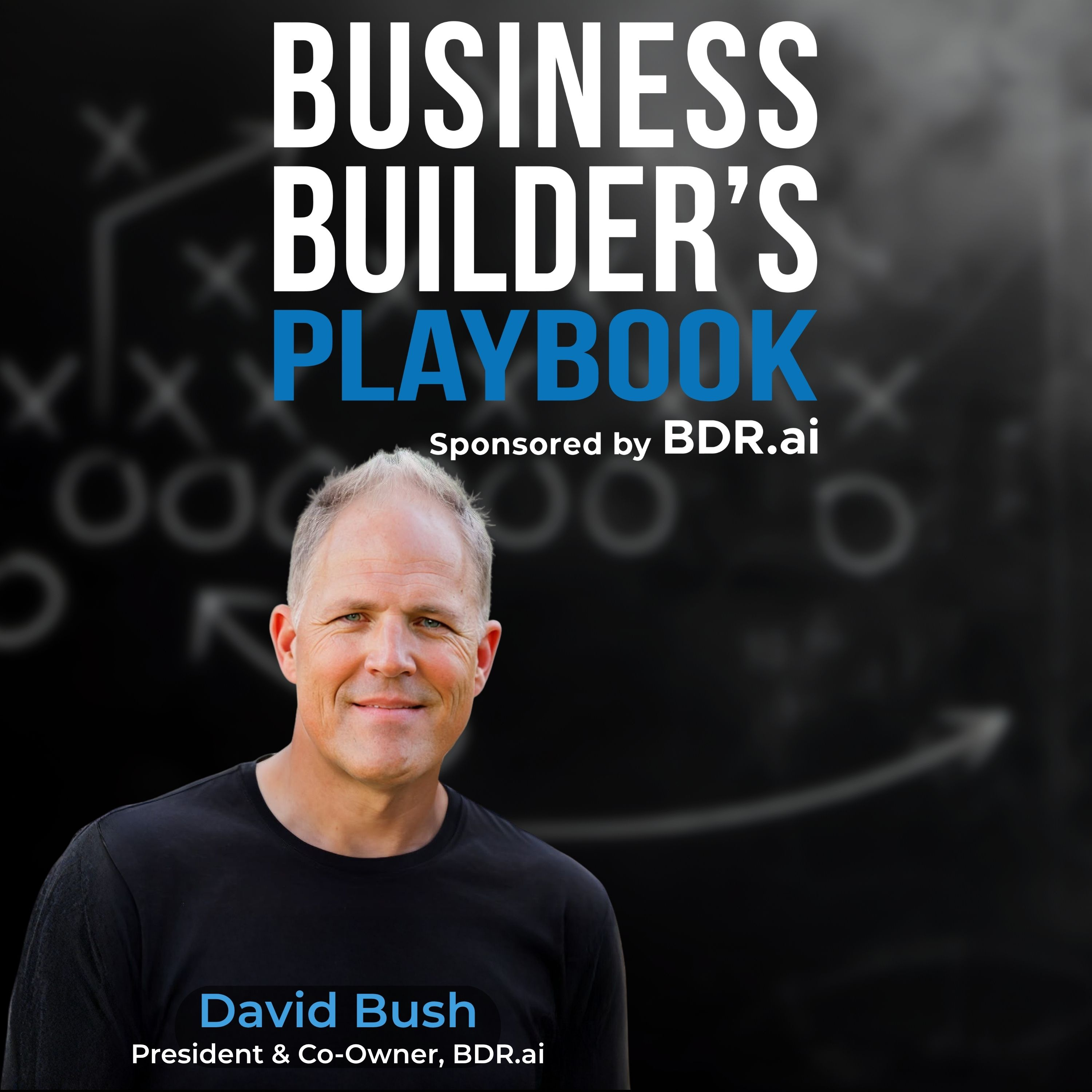
David Bush—Unlock Hidden Revenue & Profit with AI-Powered Business Development

What if the revenue you need is already sitting in your LinkedIn connections and a folder of proposals nobody followed up on?
In this solo episode of the Business Builder's Playbook, host David Bush, co-owner of BDR AI, shows founder-led B2B owners how to find the relationship assets they already own and turn them into new cash flow. David walks through the seven places hidden revenue tends to live, how to rank your contacts by trust and fit, and the 90-day pilot he uses with clients to move people from a first message to a booked meeting.
Here's what you'll learn by watching or listening to this full episode:
* How to take inventory of the seven places hidden revenue lives: past clients, old leads, lost proposals, your LinkedIn network, referrals, your content library, and strategic partners
* How to use a trust-and-fit matrix to decide who gets your attention this quarter and who gets nurtured over the next 90 to 180 days
* How to reconnect with past prospects and lost proposals using one simple "If I could show you a way..." question
* How to find referral partners, centers of influence, and strategic allies who already know the people you want to serve
* How to turn one webinar into an article, an executive briefing PDF, and short video clips that keep you in front of your network
* Where AI helps most: segmenting lists, personalizing messages at scale, triggering follow-up, and summarizing insights
* How to run a 90-day pilot: inventory and messaging in days 1 to 30, relationship building in days 31 to 60, and conversion in days 61 to 90
* How to track a simple scorecard of connections, conversations, meetings, pipeline, and closed revenue
* Why you should make deposits before you ask anyone for their time
David Bush 0:00
We all know that growth accelerates through trusted introductions. How many introductions have you received in the last 30, 60, 90 days? And if not any, why? I mean, there are people out there that need, want, can use, and can afford your services that are connected to somebody that you're already connected to, and you already have trust and credibility with them. You just haven't activated the referral relationships. Welcome to the Business Builders Playbook, the show that breaks down the systems and strategies behind predictable revenue growth to win in business. In each episode, we're diving into the proven strategies that separate the winners who scale from the losers who fail. This show is sponsored by BDR AI, the AI-powered business development platform that automates your outbound prospecting, so you can focus in on closing deals instead of chasing leads. Let's get started. All right, welcome everybody. My name is David Bush, and I'm the co-owner of BDR AI. My brother and I are business partners, and today I get the distinct pleasure to be your host and presenter on the topic of how to unlock hidden revenue with AI-powered business development. It's a topic that I've spent a lot of time, a lot of energy, in helping others to be able to do. And today I'm going to get a chance to share with you how we've been helping founder-led B 2b companies turn relationships, prospects, past opportunities into new cash flow. So that's our focus for today. I'm really hoping that you will share your comments and questions in the chat. For those of you that are watching recording, I'm glad you're here as well. Use you can use the comments section as well and put your questions in there, and I'll get back to you as soon as I see those comments pop up. So, what's the real opportunity that we're going to talk about today? We're going to talk about the idea that most of us are sleeping on some opportunities that are right under underneath where our feet are right now. They may already be in your business. If your business business is digital. It might be inside of your computer, in your cloud, or your hard drive. But I'm confident, based upon the experience of my own personal journey and the experience of other business owners that I've worked with, is that there's opportunities out there. It's hidden, though. It's oftentimes buried treasure. We have to go out there and uncover it. We have to search for it, right? And there's some ancient wisdom that says, "If you seek, you will find, right? If you if you knock, the door will be open. Ask, and you shall receive. And so, if you came here with an open heart and an open mind, I think that you're going to find some opportunities to uncover some relationship assets, and you're also going to hear about building a repeatable system. Many of the business owners, founders that I work with, do not have a repeatable system, and so that's what we're going to hope to activate today. Is we're going to uncover your hidden revenue, we're going to activate some relationship assets, and then we're going to show you how to monetize existing trust, credibility, and authority that you already have in your business right now, so this is where most of our conversations typically start with owners and founders. I don't know if this is resonating with you. It might be a little small for your screen, but it's all these disconnected systems. There's the CRM system, email automation, social media, an AI chatbot. You know, maybe there's a an inbound call or an outbound call AI system that you might be using. You might be doing events. You might be having landing pages. You may have used LinkedIn as a form of business development. But what oftentimes happens is is that these systems become fragmented, or they just become overwhelming, and it becomes very hard to gain traction. And I'm going to share with you that it's not uncommon. So if you struggle with that, you're not alone. And today we're going to hopefully solve some of that problem for you by helping you to just get really focused on what matters most.
David Bush 3:55
And we're going to stop this idea of doing random acts of business development where it's hot than cold, or it's you know on and off, on and off, on and off, and you know when you're a small business owner and you're wearing many hats, it's challenging to take on the responsibility of business development and be able to look for all of this hidden treasure. But I'm going to show you a way that you can do it, and I'm also going to show you a way that we can partner up to do it together if it's a fit for you. So I'm going to run through some slides and kind of share with you some ideas and tactics that could be beneficial to you whether you partner with us or not. And then I'm going to go through a very specific process of explaining how we go about doing this to see if that might be something that you're interested in. And then we can schedule a conversation to talk a little bit further, but this is the model that we use when we're building out our systems with our clients: is that we're helping them to capture attention using the different assets that they already have access to. Many of our clients have access to a CRM, or they have access to an email. System. They have access to social media, but they're not participating in posting content. They have access to sending LinkedIn messages, LinkedIn connection requests, and they're not doing it. They have content like webinar recordings, or they have digital assets like PDF documents, or audio recordings, or other resources that they're just not fully leveraging, or they have staff members that are actually paid staff that are underperforming and not being utilized to their fullest extent, and so we help their their staff to be able to get into action, and we put systems into place to fill the top of funnel with warm conversations and opportunities, and then we move them through the ADA principle, which is capture their attention, find out what they're interested in, get them to be interested in what we're doing, and then get them to desire that and to take that next action, so that you can end up acquiring them as a paying client, retaining them as a client, and/or expanding into new opportunities, and so let's jump in and talk about where we can find some hidden profit or some hidden revenue right now. So let's just think about, and if you you know want a copy of the slides, I'll send the slides to everybody that requests them. Anybody that registered will automatically get a copy of the recording, so you don't have to take copious notes if you want to just watch the recording. But here's a couple of jotter downers. And so, when you think about where you may have revenue or opportunity with assets that are hidden, think about the most common place where you already have some revenue opportunity started. So, when it comes to past clients, do you have a nurturing system of staying in touch with those individuals? Do you have a process for keeping track of old leads, people that had maybe reached out, website requests, emails, introductions? What about the idea of the proposals that you've sent out that didn't get converted, or maybe budget wasn't available, or maybe there was a position where you missed out because of a competitor. Have you done a good job in following up with that particular prospect? Probably not. It's probably gone by the wayside, and that's one of the opportunities that we look at. LinkedIn network. If you were to go in right now and you'd go to LinkedIn and you'd log into LinkedIn and you look at manage my network or my network at the top of the screen, and you look at the number of connections that you have. When you think about those connections that you're already connected to, you have the ability to message them, and you're not hindered by the fact that you're not connected. You're connected to them. How many of those LinkedIn connections actually match your target market and your ICP, your ideal client profile, your target audience?
David Bush 7:48
How many of those people have you been in contact with to add value, to stay top of mind, to be in a position of where you're making a deposit into their life? Those are some very simple tasks, but because there's no system, it oftentimes doesn't happen. How about referrals? Do you have a good place to track where people are referring you and who has been your best referral partner? If you were to think back over the last 90 to 180 days, who would you think is your best referral partner? Do you know? Do you have any tracking and any understanding of who is the person that's referring you the most revenue-producing activities or the revenue-producing closed deals? You might have a tremendous amount of opportunity or activity from one particular referral partner, but the deals don't close, so they may be the best referrer, but they're not the best referral partner because they're continuing to send you unqualified people, or they're just not fully understanding of what it is that you do, and they're not posturing the referral properly. The next one would be the content library. So when you think about your particular resources inside of your computer or inside of the cloud, where's the content at that is the most valuable to you? Is it videos? Is it resources? Is it third-party tools? Is it articles? Is it links? Do you have a place where you're keeping track of that particular content? And then, what about strategic partners? Who are the people that are the vendors, the strategic multipliers that you know you have a great relationship with them, but you haven't necessarily fully activated that strategic partnership where you're seeing consistent value driven back from those partners. I mean, if you were just to take a look at these seven areas and you just think about, is there any asset value to any of these? I would say there probably is. So the first thing that I'm going to encourage you to do is to develop an inventory, go through and identify where is my list. Past prospects or past clients. Where is my list of old leads? Where is the list of lost proposals? If I don't have those as a asset, I'm stepping over $1 to pick up a nickel, dime, or penny every time I go out there and chase a new lead because I've got a leaky bucket. So I want to make sure that you have a good inventory of your assets, and then go in and prioritize them so that you can take action on the ones that are the fastest way to gain new revenue. I'd love to see it in the comments if anything just has really stood out to you as it relates to this particular topic. I'm looking at the comments now. Does anybody identify one of these areas that was just like an aha moment for them? There, that are like, that's a good idea. I forgot about that. I forgot that I had that asset, and I just need to go back in there and look for it, or I need to do kind of like a collection of, you know, start writing some stuff down. I'd love to see it in the chat. If anybody has anything that just jumps out at them is like you know what I need to have a better system for tracking or uncovering this particular document. So, Eric, thanks. Lost proposals have been something I'm focusing on again. That's a great strategy, good deal. All right, so we're getting some good feedback. Thanks for popping that in, Eric. So let's talk a bit about what it is that BDR does. BDR AI stands for Business Development Rep, powered by AI. So think about the idea of having somebody inside a seat inside your organization on the organizational chart that is considered to be the business development rep. Some of you may have some of these for your organization. Well, what we do inside of BDR AI is we become the delegated person or the delegated organization that's helping you to do business development tasks, and we're putting strategy, tactics, tools, and metrics into a process so that you have something that you can measure. So the first thing that we're doing is we're helping you to pull your list together, which would be one of your hidden revenue assets.
David Bush 12:09
Many of our clients have lists of prospects. They have Sales Navigator, but they don't necessarily use it because they don't have a strategy to use it. So they have you know the $119 or the $850 a year subscription, but they're not fully leveraging it. And then you've got the digital outreach, and so so many people have tried doing some form of digital outreach, whether they've used automated sequences or whether they've done it manually or whether they've paid somebody to do it for them, and it hasn't necessarily worked, and it doesn't mean that it doesn't work. It just means that it didn't work the way that you were doing it. And there are things that we can share with you that can help you to do a better job of that. One of the things is the idea of leveraging digital events. That's not the answer for everything, but it might be the answer that you needed to generate the results that you were looking for, and to build trust, credibility, and authority with your target audience. We have an all-in-one system that I'll show you here shortly that brings everything into a process that delivers more of those book meetings, and it creates the consistency and less founder dependency, so that you can go out there and have the freedom and the desires of your heart, and you don't have to spend the time doing the business development. You are responsible as the CEO of your organization to own that particular seat. It's you're accountable to that seat, and there is no abdication. You can't just remove yourself from that responsibility. You want to take ownership of it. You just don't want to be frustrated by it and be in a position where you just throw up your arms and go, "Ah, this just doesn't work. So, if this show is resonating with you and you're ready to take action because you want to scale your business faster, smarter, with more AI and technology and less labor, check out BDR AI. We help entrepreneurs and executive sales leaders to automate the grind of prospecting, so you can focus your time on closing deals and growing revenue where you should be spending your time. With AI-powered data, digital outreach automation, and done-for-you prospecting systems, you'll connect with more qualified leads, book more appointments, and build predictable revenue without adding more hours to your week or the week of your staff. Visit BDR today and discover how our AI Prospect Finder and digital BDR agents can help you to build your pipeline and your profits. Visit BDR AI, where business builders learn how to automate and scale their playbook. So let's talk about building the asset inventory. Let's just start with with what you already own. So you already own a CRM. Are you using it? Do you have a good qualified list with the names of your past clients, your current? Clients and your prospects. If you don't, that would be step number one. Step number two would be email list. Do you have a formal way to communicate with your prospects with your clients? If you don't have one of those, we would want to focus on that. Your LinkedIn connections. Do you know who your most valuable LinkedIn connections are? Now, there's a couple different ways you can do this. You can export all of your data if you have 2,500 LinkedIn connections. You can export your data and you can organize it and prioritize it so that you know who are the right people that you should be investing your time into on LinkedIn. You can do that in a manual process using downloads, and you can send your downloadable CSV file with all of your LinkedIn connections to AI, and you can ask them to ask AI to organize and prioritize it based upon the fields that are available, or you can use technology like BDR AI that uses tagging and labels and organized campaigns to help you to organize and prioritize your assets. And many of us know this already. Our network is our net worth. Our connections is where the clients come from. It's not oftentimes that they come from being this random person that just comes into our world. Oftentimes they're building relationship with us, and that could be through a LinkedIn social media connection, or it could be coming through another connection like a referral partner.
David Bush 16:29
So we don't want to avoid the idea of LinkedIn webinar leads. Do you do any events? It doesn't have to be a webinar; it could be a live event lead. Where are you keeping track of those particular event leads. Do you have a system to move people from suspect to contact to connected to conversation to demonstration or presentation, so that you're moving them through the buyer journey? And then, how about referrals? Where are you keeping track of your referrals? Obviously, a CRM system would be the fantastic way of doing it, but do you have an easy way where you can go right now and you could pull a list of all of the people that you've recently been referred to, and can you organize it by referral partner? That would be a very cool strategy, and you would know who's the most valuable asset when it comes to referral partner, if you have that structure built into your your system, the next thing we would do is after we gathered the list, we're going to prioritize the list. So who's hot and who's not? Let's get it to a organized fashion so that you know where to spend your time. You only have 24 hours in a day, right? 168 hours in a week. You're not you're not working 168 hours, even though, as owners, we can sometimes feel like that we are. You've got to prioritize. You've got to organize your life around what matters most. And if you organize your day around the relationships and the connections and the contacts that matter most to your business, you're going to get a higher rate of return on those relationships and on the time that you spend. If you're constantly overwhelmed and you're doing random acts of business development, and you're not moving people through a specific process, you're probably going to struggle to create that consistency. Once you do the the gathering of the list and the prioritizing of the list, then you can take action in order of priority. So there's certain things that you should do today. There's certain things that you should do this week. There's certain things you should do before the end of the month, every two weeks, and your calendar should match your goals. If your calendar doesn't match your goals, then you should be coming back and asking the question, why? What is it that I'm not doing? What is it that I am doing that I need to stop doing? And we can end up helping you with some of the strategies and tactics that we've found valuable, so that you can have some extra counsel, so that you're not just winging it and doing things on your own. So, how do you prioritize your fastest wins? Well, I like using this quadrant concept or this matrix where you've got trust on the left and the vertical axis, and then you've got you know fit on the right side or the bottom the bottom side x axis. And if you're thinking about you know who has the best opportunities right now, the people that I have high trust, that are the high fit, they are the right fit conversation. They're my people. They're the people that know me, like me, trust me, and I just simply need to organize those people into a list. And if you're looking for something right now to get a quick win, I would be doing that. That's as I walked out of this webinar. That would be my number one activity. Is I would be organizing a list of the people that I have trust, credibility, and authority with, and I have a right fit. These people need what I have, they want what I have, they can use what I have, and they can afford what I have. And then I would make sure that I was spending. Ample amount of time using multiple channels of communication to add value to those people and to make them an irresistible offer that gets them to engage. If you don't do that, I think that you're again you're you're majoring in the minors. You're not majoring in the majors. The next area I would go to is who are the people that are the right fit, but I have low trust. I don't have a relationship with them that's high trust, high credibility, high authority.
David Bush 20:28
That would be my next group of people that I would be building relationship with, and that could be your second degree connections on LinkedIn. It could be referrals that could have been possible if you would just ask for them, right? There are people that you could actually go out there and today you have a relationship with them, and you could add value to those people. And you may not have a deep trust relationship, but you've met at a chamber function, or you met at a networking event, or they're a friend of a friend. They're the right fit. They're the right referral partner. I just need to go out there and I need to nurture that relationship, making small deposits of relationship value. You know, I'm liking their posts, commenting on their post. I'm sharing their content. I'm engaging with their content. I'm doing things that are valuable, such as asking questions, hey, who's a good connection for you? Who's a good referral partner for you? And I'm trying to build that relationship equity so that I can get the opportunity to come my way. It's just not going to be right now. This is my next 90 days. High trust, high fit is my next 90 days. This nurture is going to be 90 to 180 days, but I'm going to generate opportunities within this group in 90 to 180 days if I have a dedicated amount of activity happening. All right. Step three: reactivate warm relationships. So go back to some of those old conversations and bring them into some new opportunities. So the way that we do that is that we start off with just a reconnect message. So I was thinking about you today, or hey, I saw your face pop up on social media, and I was thinking about you, and I was just thinking this might be something that you would be interested in, or I met somebody the other day that might be a valuable connection. I would just like to have a conversation with you to just see if this is a right fit. If I'm on the right track, make sure that it's still a right match for you. Have something where you're adding value to bring these people back into conversation, and then ask the question. And the question, this is a jotter downer. If you've navigated away, come back and be present here. The question is this, and I'll use Eric because he was the one that commented. Eric, if I could show you a way where you and I could partner, and we could help more people to do what it is that you want them to do, and we could both benefit, would you be open to how we could do that? Would you be open to exploring how we could do that. Ask a question that's relevant to what it is that they want and what it is that you want from them, and then just ask the "if only" or "if I if I could" conversation. If I could show you a way. If I could come up with a strategy. If I could come up with a simple solution. If I could come up with a package. If I could come up with an event, if I could come up with a sponsorship, if I could come up with a strategy, would you be open to exploring that further? That simple conversation will curate interest, and it's built on value, and you're reconnecting with people for that, and that could be a past prospect. Hey, I was thinking about you. I know that you had decided to go with a competitor, but I was just curious if I could show you a way where we could end up helping you to do what you said you wanted to do at a competitive cost. Would you be open to exploring the solutions in the future? Bring people back into conversation and book that call. And there's so many different ways that you could use AI. Right now, you could go into AI and you could say, using this question structure, if I could show you a way, would you be willing to, and then give them structure as to what you're trying to connect with?
David Bush 24:18
I don't know all of your businesses and what you do and how you do it, but that would be the thing that I would be focusing in on. So I appreciate the feedback in there. Yes, Eric. Yes, I know you're saying that would be a great strategy. So if you go to AI right now and you use that sentence structure, I'd love to see the feedback in the comments if somebody has their AI opened up. Just write in there and say, create a re-engaging or a reconnecting script to my particular prospect or past clients, and use the phrase "if I was able to. And again, you're going to want to focus on what. Their interests are. If I was able to show you a way where you could make your website better, if I was able to show you a way where you could improve your business development, if I was able to show you a way where you could do what you wanted to do, and I could help you to get rid of the things that you don't want to do, would you be open to reconnecting? Now you got to create the value to get them interested, right? The whole ADA principle is you got to get their attention, and you typically get their attention by saying something that's valuable or bringing value to them, and then attracting them to the interest. Should it be something that they're struggling with or that they're interested in, and then you get them to desire having a conversation with you. So if anybody gets that put in there, I would love to see it in the chat. Would love to see the feedback. These are some of the ideas that I would end up working with our clients on together and doing kind of an ideation to come up with those strategies so that we can build out messaging sequences to go back out to those prospects or those past clients and referral partners, and get them engaged, and get them replying to LinkedIn messages, or emails, or in-mails, or whatever the strategy is. All right. So step four is expanding the relationship ecosystem. So we all know that growth accelerates through trusted introductions. So how many introductions have you received in the last 3060, 90 days? And if not any, why have you not had any desire to build those relationships? I mean, there are people out there that need, want, can use, and can afford your services that are connected to somebody that you're already connected to, and you already have trust and credibility with them, you just haven't activated the referral relationships. Yeah. So Josiah says, if I was able to show you a way to turn more of the interest you're already getting into qualified conversations without spending more on ads, would you be open to reconnecting? That's a great one. Josiah does websites and does lead generation. That's a great strategy. Anybody else put that into AI and get some feedback? Let's get some comments in there. I'd love to see everybody else's feedback on there. So, referral partners. Who are the people that are already working with your clients? Already working with the people that you would like to serve? They already have a relationship with them, but you have not earned a referral from them recently, or who are the people that you have earned a referral from, but you'd like to get more out of? That would be somebody that we'd want to identify, and then who are the centers of influence? In Seth Godin's book, Idea Virus, really popular book. I can't remember when it was published, but it was a free book. It was one of the free eBooks that came out where he published the book and gave it away for free via PDF, and he required people to put in their email addresses, kind of like a lead magnet, and then he gave them the you know 300 and some odd page book, and when people downloaded the PDF and they read through the PDF, they were like, "Man, this is a great book. I'm going to go out and buy the book, and so it became a bestseller.
David Bush 28:04
So what he talks about in that book of Idiovirus is who are the centers of influence that are the people that, if you could get them to use your services, there would be a whole lot of other people that would use them because those people are sneezers. They sneeze the virus of your business onto other people because of their nature, because of their affluence or their influence. And so, if you think about, like for me personally, I'm I'm looking to build more relationships with authors, speakers, and experts on the topic of business development, because most of those people don't have a system that creates business development. They're an expert on business development, and so if they was if they knew that there was a system that they could refer people to, that could actually earn them trust, credibility, and some revenue because they were referring business to it, and it was something that made them look like a more valuable leader. They would probably send it over my way, and I believe enough in myself and our services that I'm willing to have that conversation. And then, who are the strategic allies? And the strategic allies are anybody that's in the marketplace that you're currently spending money with, or you're currently building relationship with that are also connected to the people that you want like to generate referral partnerships with, or that may have people in their network who could be potentially introduced to you that just may not be like a direct referral. So for my business, there are people out there that are, you know, pastors. They're ministry leaders. They're nonprofit leaders. They're not really my best referral partners, but they're my most strategic allies. And I try to do things to help them and their organizations, even though they're not a true prospect of mine. In hopes that I can end up building. More relationships, so I'll go in there and I'll share their content. I'll comment on their post. I'll do warm introductions and introduce them to people that may be beneficial for them. And those people oftentimes become indebted to me, where they feel like that they need to do something to continue to receive my introductions and my referrals, and so that's a good relationship for me to have. Webinars, doing events, or doing virtual events or live seminars, partner offers-you know, offering to share something that one of your partners has distributed. If it's something of benefit to your clients, making it available if they have an event, you know, I had some partners and centers of influence and allies that shared my webinar today because I asked them. I said, "Hey, would you mind extending my reach? Would you mind sharing this resource? I'd really appreciate it. And then you also have the shared audiences, so you've got people in in your follow up. What about the idea of you know how that could end up helping somebody else? Is there somebody in your network that could benefit from knowing about one of your strategic allies? So, would love to have more of you sharing ideas as to what's something that you can do to expand your relationship ecosystem and build more trust and credibility. One of the things that I have found to be very very successful is the idea of using authority-based content. I call it the content to client engine, and we basically are taking the expertise, experience, and education of our clients, and we're putting it on display in a live webinar that becomes a conversation or a interview where I'm asking them questions. So we do this for our clients and for our referral partners, and it's worked extremely well. It's a great way to reciprocate value. It's something that we can bring to our referral partners. It's something that we can bring to our clients, and they'll actually find value in it, and they'll pay us to do it, but having a webinar is a strategy around exposing what it is that that person knows and is an expert on, or is very experienced on, and then we turn that webinar into a digital article, and I'll show you some of this in just a moment.
David Bush 32:15
And then we turn that digital article into a PDF document that's a an executive briefing that now becomes an attachment that they can offer as a complement to their proposals or just as a reference to be able to show that they know what they're talking about. Video clips is another strategy. We take a one hour webinar and we'll cut it up into smaller video clips that are one to three minutes in length, and those video clips are content creation where you get a chance to nurture relationships. So when people go to your social media profile and you're sending them messages and you're engaging on their content, they're more likely to see your content. And if your content is something that is a video that you're speaking confidently about a topic that they are experiencing, you're probably going to become more valuable to that person than if you don't do some of the videos and some of the content creation. So, where does AI play into all this stuff? That's a good question, and it's up to you to decide. I have found AI to be extremely valuable in doing segmentation of lists. I can use AI to find individual prospects and find individual target industries. I can also have AI sort large amounts of data so that I'm looking for very specific pieces of data. I also use AI to personalize messages at scale. So when we set up an automation sequence, I can choose certain messaging that's going to help me to get more of a connection or a conversation. It's not perfect, but I make up in numbers what I lack in perfection. So because I'm doing more of it more consistently. I'm getting more conversations started. I'm building more qualified meetings, and that's something that I'm willing to trade off. And it's only going to get better. AI is going to get better over time. You can also use AI to trigger follow-up. So you've got certain triggers inside of your CRM, or you've got AI built into your own projects or your own skill sets, and you've got Claude dialed in to make sure that it's awakening you when there's a certain time frame that's elapsed, or when there's certain things that are posted on social media. And then it also is a great strategy. It's probably one of my most strategic strategies is to summarize insights, so when I'm done with this particular webinar, I will download the transcripts from Zoom, and I will download the video recording from Zoom, which is a typically an hour-long presentation, and I will upload those into my AI tools, and I will. Create an executive brief that is written in my voice, but it's more in a written format versus a speaker format, and I'll be able to provide that as an article on LinkedIn. So I'll get a repurpose of this one-hour webinar on social media. I'll also get a document that I can send out as an attachment, which becomes another valuable resource in my LinkedIn profile, because I upload those assets into my profile as a document, and then I can also use the newsletter as a resource as well. And then I'll upload the video and I'll create those one to three minute video clips, and all of that is helping me to support relationships. It's not replacing me. It's just making my content more available, and I'm becoming more capable to the target market that I'm reaching out to. So here's the 90-day hidden revenue pilot program that I would encourage all of you to take action on. So the first 30 days would be get an inventory and develop a messaging sequence that could get you started in conversation. You don't need to be perfect, right? You can't say the wrong thing to the right people. Don't be perfect about it. Just start the conversation. Days 31 through 60 is when you're going to activate and nurture those relationships. So don't be in a hurry to get on the phone with people. Just use the next 30 days to build relationship, to add value, to just know who you're focusing in on. Make sure that you're delivering valuable messages, and then you can start to make the invitations.
David Bush 36:35
After you've done a few gives, then you can do the ask for the time, which is money, to very important people, and so anytime you're asking somebody for time, you're asking them for money. So you always want to make sure that you have a deposit on account before you ever think about making a withdrawal. And then day 61 to 90 is when you're going to convert and scale. So if you want to have more clients in the next 60 to 90 days start with the process of first taking inventory, building out that messaging sequence, and if you don't know what to say to them, then that's when you hire a professional to help you. So that's very important. And then I would just make sure that you are measuring metrics using a scorecard of some sort, where you're measuring the number of connections, the number of conversations, the number of meetings that you're scheduling, and then what are you adding into your pipeline, and what is turning into closed revenue? If you don't have a metric for measuring, you are oftentimes just winging it, and winging it doesn't lead to high-level success. So, what are your high-priority campaign plays that you're going to do. I would just maybe focus on five. First and foremost, I'd focus on my LinkedIn action or my LinkedIn network activation. I'd be organizing and prioritizing my first-degree LinkedIn connections, and I'd have certain people that are listed as referral partners, certain people that are listed as clients, certain people that are listed as multipliers or strategic conversations or strategic relationships, they're not really a referral partner, but they could be somebody of value. And then I would have my prospects. I would have that organized and prioritized because that's my fastest way for communication outside of email and outside of picking up the phone. And I can get a lot of conversations that way. And then think about client ascension conversations. You know, who are you currently working with right now? Who could use a step up? Maybe there's more services. They need another account. They need something different than what they have. Do you have a list of those particular people? If you don't, that would be my next place that I would be spending time and focusing. Referral partner outreach: draw a circle on a page and draw 10 circles connected to that around it. Think about like if you had a football huddle, right? So the quarterback gets in the huddle and they had he has or she has 10 other people surrounding them in that huddle. Who's in your huddle? If you were to think about the people that need, want, can use, and afford your services, what other services are they buying? Who else could you talk to, and how many of those people in each one of those categories do you need to build a relationship with, so you know if I'm thinking about Josiah doing websites, I'm saying, okay, Josiah, who are the people that are thinking about connecting to the same people that you're connecting to that could refer you or endorse you, or could add your services onto their offer, right? So think about business coaches, digital outreach businesses like myself. We have a relationship and we have a partnership because you've chosen to partner with a business development company. Business coaches, life coaches could be another one. That might be a one-off. Insurance agents. Who are who are some other people? Brainstorm with me, guys. Throw it into the chat. Who are some of the people that work with people that need websites? Just think about the industry titles. IT people. Like brainstorm out, and again, you've got AI in front of you. I know you can do this on your own, but this would be a very simple one to just go into. That's great, Jason threw in there. Branding agency, cybersecurity agency. Again, if you go into AI and you just put in and you go, what are the top referral partner categories for a website company or a website designer, and it'll give you all the different categories, and then go out and look for those people on LinkedIn using Boolean searches or using basic search features, and you can find those individuals. All right. So the next one I would do is I do the loss proposal follow up.
David Bush 41:01
So these are people that already requested a proposal, or you already got to that stage. Do you have a system for following up with those people? And then old lead recovery. What are you doing for those people that were maybe in touch but fell out of touch? Do you have a system for staying in contact with those people, starting off with social media, your CRM system, your email system, and are you feeding those people? Like, if you were to build a flock of sheep, right? You'd have a fence, and you'd say, "Okay, this is my flock of sheep. This is my sheep pen, and you would feed those sheep, you would water the sheep, you would protect the sheep from wolves if they tried to come get your sheep, because they're valuable sheep, so you would protect them. You protect them from disease. You'd help them if they were hurting. You'd help them if they were lost. You would know who your sheep are. So go back to thinking about being a shepherd of sheep and thinking about how do I organize all of this into a process that's easy for me to track, and then track it. Track how many replies did you get? How many calls did you schedule? How many meetings did you complete? How many people did you move into the pipeline as a projected deal? And then what did you get in terms of closed revenue? That's going to be where the magic happens, right? You're going to have to have that metric or that scorecard, and you're going to have to own it as a founder. That's going to be something that you're going to need to take extreme accountability for if you haven't already. So, if you want to partner with us, what I would be doing is that I'd be asking the question: Where is the revenue? Where is the hidden opportunity? Which list do we want to focus on first, and how should AI help? I'll answer that question for you. I'll show you exactly what has worked for us and what works for other others in our marketplace and the people that we've been successful for with, so that you don't have to reinvent the wheel. And if you want to have that conversation offline, then I'd love to have the conversation with you. I'm going to go through a few slides and show you some of the things that we do. But my contact information is just go to bdr AI and hit the contact us. All of those opportunities are booked right through our scheduler, and we can get you scheduled for a conversation. Talk about your inventory of your assets, help you to craft a plan, and then launch a 90-day pilot program if you're ready to get started. So what that looks like typically in processes is that we organize and prioritize your LinkedIn connections using automation and using our BDR AI platform. So we'll organize and prioritize first-degree connections, second-degree connections, and then if you choose to do a webinar, we'll put together a specific webinar, and we'll target people that you want to invite to that webinar, and then we'll track every single person that shows interest in the LinkedIn event and or the registration page on Zoom, and we can pull data from third party data resources. So if you want to, you know, go out there and make a a big push for specific people that match a certain target market or a certain ICP, we can do that geography wise, or we can do it industry wide, or a combination of different variables. We can even do trigger data that's based upon people searching for certain prospective information or certain targeted information, and then we can actually provide you with verified email addresses, phone numbers, and all of the data that you would want to make sure that you had enough information to do your due diligence before you started engaging those prospects. We organize automated campaigns using omni-channel communication. So what that looks like from a step-by-step process is typically we start with LinkedIn first because that's where we have relationships. That's social media. It's very popular to connect with people on social media. Before sending an email to them, I would send a connection request, and then I would try to either.
David Bush 44:59
Message or comment on something that they posted, and then I would end up having an email that would go out there to remind them that I had already engaged with them on LinkedIn. And if you decide to go the email route first, that's okay too. We can build the sequences to match your personal preferences, and our system can send out up to 250 emails per day inside of a sequence. So think about taking 1000 or 2000 prospects that you know match your target audience, and you're sending them out messages, commenting on their post, liking their post, endorsing their skills, following their profile, and then also emailing those individuals to let them know that you sent them those messages for more accountability. This is what it looks like on the inside of the system. We build out the sequence, we build out the steps, and then we launch the campaign. And we have done this so many different times where we know, you know, pretty consistently what the results are going to be. We don't know everybody's industry the way that they do, but we can tell you that you're probably going to get somewhere in the ballpark of a 25 to 35 percent connection rate. You're going to probably get somewhere in the ballpark of a five to 10 percent reply rate, unless you have a really good offer and a really good message and profile, and then you're going to be able to book meetings with those percentage of those people. Usually, it's eight to 12 people a month. That's what we try to shoot for. But some of our clients have bigger, bigger cost, higher ticket items, and so their their numbers are a little bit lower than that. And then we're going to check the unified inbox, and that unified inbox is something where you can use AI to respond. So you can click on these little master prompts. You can type in a prompt, and it'll take what's been said and what has been posted in their profile, and it'll rewrite a message specifically to that target audience. You can also use canned responses that you've created as save templates, and all of that can be done in a very short period of time, and we even have human appointment setters. So for people that are looking for a done-for-you strategy, they don't want to learn technology, they don't want to pick up another platform, they just want to amplify their outreach, and they want to make this to be a delegated position. We have those people that can do that follow-up work for you, and they can manage the entire campaign. Our system has an integrated calendar that you can integrate, and you can utilize like a Calendly link. We have a CRM system where you can use for customer relationship management. You can build out, you know, specific tags. You can organize, prioritize your contacts inside of our system, and that's something that can end up building out your email communication. You can also build out subscriptions or documents that you're going to use for signatures. You can organize your shopping cart. Everything can be done from inside the one platform for those people that choose to do the done-for-you service. If you're collecting payments or subscriptions, all of that can be done right inside of this particular platform. You can develop AI agents, and we offer this to all of our clients. Can end up doing this one all-in-one system, and then they can basically pay for a certain number of service hours that we can do these types of projects. So, if you want to build AI agents for your website or for your support system, this is the services that we would utilize to build that out. You can develop your social media calendar inside of our platform, so you can connect to the different social media accounts that you have, and then you can do one particular post and have it broadcast to multiple different platforms. So here you can see I have both my LinkedIn personal account and my business account, and then I've got the ability to write my post.
David Bush 48:52
I can write the first comment so that the comment gets posted after the post is generated, and then I can go ahead and I can schedule that post and put that in as a scheduled post for later, and that goes to all of my social media platforms. So we give our clients strategies on how to create content in advance, so that it becomes kind of their one-to-many strategy, where they're showing up they're showing up on a digital standpoint. So when people go to search for your information, they see relevant, current posts that you've been sharing that complements what it is that they think of you, or or adds to the point of what they think of you. So they don't know you yet. They see you as being an influential person. They see you as being an authority. They see you as being trustworthy because there's content that backs it up. It's not just an empty promise or a website that you're sending them to. You can you can develop funnels, websites, webinar registration page right from inside this platform. You can create membership-based sites or communities that you're basically licensing or giving. Access to, you can also end up storing all of your media files, so that if you want to share something from the cloud with your prospects or with your clients, you can resource it back here in the media file. You can also increase your reputation management, so your Google, your Google ratings or your rankings, all of that stuff can be done from right inside of this platform. There's also even a local marketing audit where you can go in there and you can run reports and just see where's areas that I could be improving my branding or improving my presence online, and that's something that we can give you some guidance for as well. You can use the photo or the phone app to be able to run your business. There's all kinds of support available, including 24/7 24/7 support via live chat, as well as online meetings where you can schedule a Zoom meeting and actually get help in creating these resources. There's done-for-you options where you can submit done-for-you request, and we'll complete the request based upon the service hours that you've selected inside of your subscription. And then we've also got a whole bunch of trainings and opportunities where you can learn, so that if you have a staff member or you want to do it more on your own, you can actually learn how to do it yourself, or you can delegate it to a member of your staff. And there's a whole bunch of different videos and resources that help you to do that on your own. This is the all-in-one option that's available through BDR AI. We still also have clients who do kind of more specialty products where they have like the digital outreach automation, or they do a webinar, or a combination of the two. This is our all-in-one. This is everything's included, and the starting price is $697 a month, and that comes with four hours of support. So think about four hours of appointment setting support. Somebody that's managing your inbox and is following up with your leads. That could be a human being that's following up with your prospects for $697 a month, and that's four hours every week. Or if you needed more support from a digital standpoint, and you wanted to have more help with your CRM, or you wanted to have more help with your digital outreach campaigns, you could allocate more hours towards that and less hours towards the appointment setter, and then as your business begins to scale, you can add more hours and buy more credits, and then that'll give you the ability to increase your support or decrease your support down to the base level. Any time you can decrease your support, and then you can come back to this level. We do charge a one-time onboarding fee of 2497, which ends up helping us to get everything set up. We develop your ICP, we refine your marketing messages, refine your campaigns, and make sure that we launch you with a high level of success. So, I hope that this has been valuable to you. I hope that you got a few ideas.
David Bush 52:59
If you still have questions, you can reach out to me using the contact us, and would love to be able to have a conversation with you. But if this has been valuable to you, send a message, send us an email. You can send me an email at david at bdr AI, or you can post it in the comments. And sure, we'd love for you to share this recording with others if you are watching the recorded version, so thanks everybody. Wish you the very best. Take care. Thanks for tuning in to the Business Builders Playbook. If this episode gave you some plays that you can start running in your business today, hit subscribe and share with another revenue leader who's tired of the pipeline grind. Building predictable revenue isn't something you figure out alone. Whether you're looking to automate your prospecting with BDR AI, or you just want to talk through the growth challenges you're facing, reach out. We help business leaders just like you to build systems that actually scale. And if you're ready to stop being your company's highest-paid prospector, let's have a conversation. Reach out to us at bdrai. Until next time, let's keep building.
Business Development Automation Expert
WHAT I DO:
👋 I partner with B2B business owners, coaches, consultants and executive sales leaders to optimize and expand their business development efforts by combining decades of business growth expertise with cutting-edge AI technology.
We provide premium B2B data, AI-powered digital outreach sequences, high-converting lead magnets, lead generation tools, and digital dialing solutions to accelerate outbound outreach.
🔑 WHAT I CAN HELP YOU ACHIEVE:
✅ Increase Sales & Revenue with cutting-edge tech tools, AI BDRs & AI solutions
✅ Automate & Scale Your Business
✅ Create Irresistible Offers
✅ Optimize Your Mindset & Motivation
✅ Increase Productivity & Performance
✅ Build a Sustainable Business
🌟 WHY WORK WITH ME?
🤖Whether you’re looking to fine-tune your use of AI strategies, automate lead generation, or grow sales, I can assist you!
🔹 Entrepreneurial Expertise – I have personal experience in 2-10x sales/profit to get you to the next level.
🔹 Proven Track Record – I’ve assisted hundreds of business owners and sales leaders to achieve extraordinary results in sales, revenue, and business growth.
🔹 Author & Speaker – I’ve written two books and delivered transformative talks to entrepreneurs and executive sales leaders.
📖 MY STORY🏈
As a former professional football player and collegiate All-Conference Offensive Center and Captain, I learned the importance of discipline, teamwork, and dreaming big.
My career highlights include:
🏆 P… Read More