Jacob McGill—The Growth Engine: 7 Strategies to Turn More Traffic, Leads, & Follow-Up Into Revenue

What happens when a $60,000 job goes to the ninth company that picks up the phone?
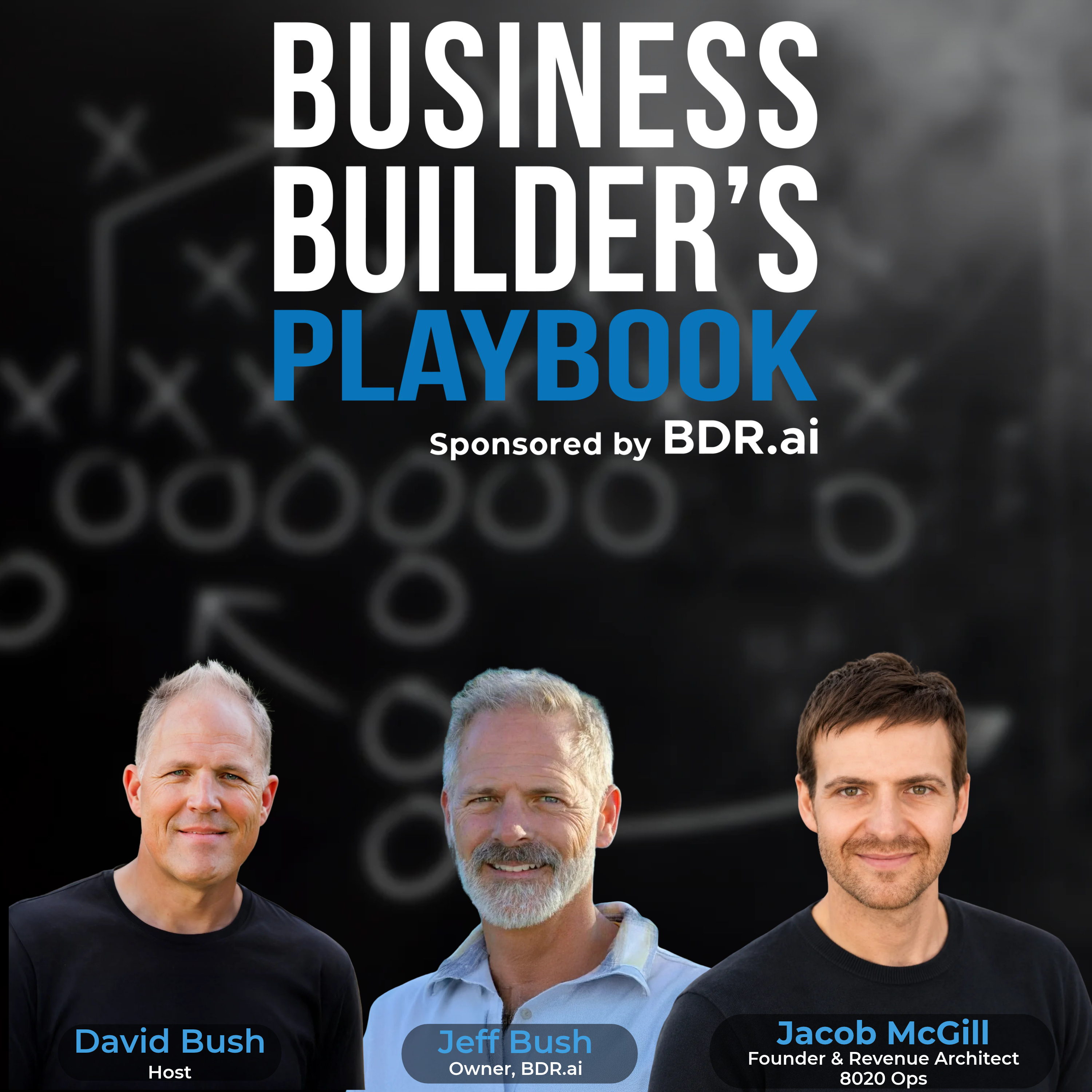
In this episode of the Business Builder's Playbook, host David Bush sits down with Jacob McGill, founder and CEO of 8020 Ops, and BDR AI co-owner Jeff Bush for a live Q and A on the growth engine behind predictable revenue. Jacob shares what he sees inside client businesses, from an automotive client with 6,000 past customers and no second follow-up to a voice agent that responds to a lead in 32 seconds. Jeff brings 30 years of sales and lead generation experience, including a year spent raising his closing ratio from 7% to 8% on a $200,000 monthly lead budget. Together they cover where revenue leaks between marketing and sales and where AI belongs in the process.
Here's what you'll learn by watching or listening to this full episode:
- How to find the revenue leaks at every step of the customer journey, from first lead to closed sale.
- How to cut speed to lead with a voice agent that responds in 32 seconds and hands the conversation to a human.
- How to track the numbers Jacob and Jeff watch, including cost per lead, cost of acquisition, and the line between a marketing-qualified and a sales-qualified lead.
- How to put a voice web agent on your website, why it can train itself from your site in about 30 seconds, and the 37% increase in conversion Jacob reports.
- How to build an ideal client profile from your current customers, and why Jeff calls most intent data smoke and mirrors.
- How to give each ideal client profile its own campaign and speak to what that buyer has already researched.
- Why system and process come before technology, and what IKEA's AI rollout shows about moving call center staff into design consultant roles.
- How to automate follow-up so humans spend their time on the sales call, the way Jacob reaches a 96% show rate on ad campaigns.
- How to sequence your build: CRM first, voice agent second, then AI assistants inside individual roles, with a security check before anyone vibe codes a tool.
- How to run a 90-day plan around your list, your offer, and your timing, and test 20 offers in seven days.
Jacob McGill 0:00
Speed to lead, how quickly people are responded to, is probably one of the biggest ones right now. That is a solvable problem, especially with where AI is coming. You do not have to wait for a person to feel like picking up the phone. You can have a 32nd response with a voice agent, and then you can hand that off to a human.
David Bush 0:21
Welcome to the Business Builders Playbook, the show that breaks down the systems and strategies behind predictable revenue growth to win in business. In each episode, we're diving into the proven strategies that separate the winners who scale from the losers who fail. This show is sponsored by BDR AI, the AI-powered business development platform that automates your outbound prospecting, so you can focus in on closing deals instead of chasing leads. Let's get started. Hey, welcome everybody. My name is David from BDR AI, and today I get a chance to be the host and moderator for this exciting live Q and A webinar on the topic of the Growth engine: seven strategies to turn more traffic, leads, and follow-up into revenue. And I can't wait for you all to hear the answers to the questions that we're going to pose today. Because a lot of the questions that we're going to be asking are the ones that you've been thinking about, and they've been keeping you up at night, or they've been getting you up early and keeping you up late at night, trying to solve these particular questions, and today I've got two experts that are going to be sharing some of their background, expertise, and experience on turning these strategies into more predictable revenue. So today I'm joined by Jacob McGill. He's the founder of 8020 Ops, and he has got a tremendous background. I don't, I can't even do it justice because he's got so much experience and expertise in the topic that we're going to be addressing today, and then alongside of me we have my partner Jeff Bush, owner of BDR AI. So, welcome to the webinar, guys. Excited to jump in today. Thanks, Dave.
Jacob McGill 1:55
Thank you.
David Bush 1:57
So, Jason, let me start off with you. Just why don't you give everybody a bit of a background on what got you to the point where you're at today, and tell everybody a little bit more about what you do and for who.
Jacob McGill 2:09
So we started as a cloud-based company like 12 years ago when I kind of shut down my former business and took a bit of time off, and was like, "What do I really want to do next?" I had decided that I wanted location independence, and I built the whole thing on a Chromebook at my now over 30 countries that I've been through, and that's because they all had Wi-Fi when it came down to it. So that's what got me here. We originally started as a done-for social media, just a sawmill method, following Gary V's lead, and you know, producing content, batch outputting, and we landed some pretty decent-sized clients. One of my favorite in the first couple years we were around is a brilliant company funded by a UK bank that had turned the last five intact tropical rainforests into carbon credits and was selling them to airlines, and we got some wins. Like on Twitter at the time, airline executive would say super interested in this, and then we'd start pulling our hair out because we're like, well, you need to respond to them. Like you have to actually go in, and when they call, you answer. And you know, fast forward through that, we became a CRM-based company because we got tired of the leads that were generating falling off the flat Earth and all of those problems. And about four and a half years ago, one of my best friends said, "You really need to start looking at this revenue architecture stuff, and for anybody who doesn't know what that is, it is let's focus on the customer journey end to end. Let's solve the fact that there are revenue leaks every step of that customer journey, and let's focus on making the customers happy because crazily enough, they're the ones that are spending money into the business and putting the lights on, and so you end up with these ironic statements where it's like, "We have clients, but I care more about their customers than I do about them in the end because it's their customers that are actually paying us." If you think about it,
David Bush 4:15
that's great. Well, we're going to jump into some specific questions about the biggest leaks that you're seeing in marketing activity and actually converting that to revenue. But Jeff, tell everybody a little bit about your background and what brings you today on this particular topic.
Jeff Bush 4:32
Well, been involved in sales and marketing and lead gen for 30 years. You know, both on the B 2b side, B 2c, and now through AI, you know LinkedIn, what we're doing now. So I think I have some experience in it. I mean, I used to spend $200,000 a month to get 1000 phone calls into the building where we closed 100 mortgage loans. You know, that was in the mortgage business for 10 years and. And so I spent a lot of money on lead gen, and I've hired 1000 salespeople, and seen how some close 20% of their phone calls, and some close 2%, and always trying to figure out what's wrong, and you know CRM and bolting everything together, trying to make it work better. You know, I remember one year I I did the math. If I could take my closing ratio from 7% to 8% on the existing $200,000 month spend. I would have made an additional million dollars, $1 million net profit in my pocket. I taken the closing ratio up 1%, and I worked hard for a year, and I got it from I think it was like seven to eight, and it was wonderful. And but it took a year of hard work to do that. It was no easy task. You don't just flip a switch. It was like the calls come in. Do they go into the CRM? How fast are we calling them? A lot of times, what I did is just fired the worst salespeople. I mean, one guy's closing at 20%, one guy's closing at 2%, taking the same phone calls. It was amazing to me. So every month I fired the guy at 2%, hired a new one. So I was churning my sales team on purpose. I was worse than McDonald's. I had like 50% churning the sales team on purpose. Love doing it every month. If you can't convert these $200 phone calls coming into your desk, you're out of here. You know, and that was as a sales manager managing sales, I had to get tough on that, so whatever generating leads, closing leads, you know, increasing closing ratio. There's a lot of money sitting there for companies and and to scale. I was just thinking about something where one of my clients was LendingTree. Dude, LendingTree 10 years ago they did $4 billion in revenue. I go. How much did you guys spend on advertising? 1 billion, 1,000,000,020. And people are like, I'm not going to spend money on marketing. And well, you'll never be LendingTree $4 billion. But it was interesting. LendingTree decided to buy a mortgage company, so they looked at 100 mortgage companies that were buying LendingTree leads, and they bought Home Loan Center, who was a client of mine. And the reason they bought them is their closing ratio was 8% on the leads, where everyone else was six. So they made a decision on buying a company based on their close ratio. That always shocked me. That was a $200 million exit for Anthony Shea, who's now a billionaire. He owns Loan Depot, and it was just fascinating that LendingTree bought his company off his closing ratio. He had a better system of answering those calls faster, and whatever he was doing, email and text, and you know nowadays it'd be AI, you know, to step up your game. But so, anyways, just been involved in high-level sales and marketing for a long time, and I love it. It's fun, so I think yeah. Well,
David Bush 7:48
today we're going to be talking about how to connect outbound to inbound traffic to conversion to lead generation to nurturing and sales follow-up, and then having all of that turn into predictable increase in revenue. So, I'm going to throw the first question out that we received over to Jacob. So, Jacob, where do you see the biggest leaks between marketing activity and actual revenue based on your experience?
Jacob McGill 8:14
Yeah, I'm. I'm actually going to pause in that by saying I hope everybody noticed something really important in Jeff's answer, and it's why I love people like Jeff. He was using numbers. There was metrics. There was math, and like that's the real answer to your question, David. Because you have to measure what matters, and everything matters in the customer journey, in my opinion, so we see revenue leaks all the way across the board, right? From lead to conversion to sale, there are always consistent revenue leaks, and they kind of get granular and differ from business to business. But speed to lead, how quickly people are responded to is probably one of the biggest ones right now that is a solvable problem, especially with where AI is coming. You do not have to wait for a person to feel like picking up the phone. You can have a 32nd response with a voice agent, and then you can hand that off to a human, right? And and this is one of those things. I'll put a pin in the IKEA case study that I'm bringing to this call today for a little bit later. But they saved millions and went on to generate billions by thinking this way, and they did it in this calendar year.
David Bush 9:36
That's great. I know that conversion is a big part of Jeff's. Obviously, you just heard about his passion about going up 1%. Is that he spent a whole year by increasing by 1%? But Jeff, a lot of people use the phrase, "I just need more leads" or "I need more traffic to my website," but that's really not the answer because many people don't have a system to convert that. Traffic or a system to convert those leads. Talk a little bit more about what you've seen in other businesses that have just not ever developed a good solid system for conversion.
Jeff Bush 10:11
It's a great question. I mean, I'm always looking for more leads, but I had a system in place that worked. If my system isn't working, and the math doesn't math. If I get 1000 phone calls into the building and I close 50 deals, and I'm spending $200,000, my cost per acquired customer is too much. I'm out of business. But when I got it to the point of closing, whatever seven or 8%, the math worked, and now I can increase leads. But it's like making sure the system's buttoned up tight, and I just remembered something where, you know, you get these lead forms, and you you go online. Like if you go on Long Depot's lead form right now and start filling it out, just put your name and your phone number before you put in your address. Your phone rings. They were calling people before they finished the form, this was seven years ago, and I was like blown away. Like because LendingTree sells that lead three times, and the first person to get a hold of them, speed the lead, gets 50% of the business. So Home Depot was dialing the phone number, calling the person. They're like, I I haven't filled out the form yet. I haven't even hit submit, and they knew they were available on their computer typing, so they're going to pick up their phone. It was crazy. That was one of their tricks: feed to lead conversion, and why LendingTree paid you know a couple 100 million to buy HomeLoan Center, whatever that was, 10 or 15 years ago. So I don't know if I answered your question, but I just remembered that that that was uh kind of crazy, you know how how fast. So yeah, I need more leads. You know, once my system's in place and I'm profitable, every month I spent 200 grand. I made 200 grand every month. I made $200,000 profit with a $200,000 lead spin, and and and I had a friend goes, Jeff. Last year I spent 10 million on marketing. Guess how much money I made? I'm like, how much? He goes, 10 million. I'm like, oh my gosh, I could have scaled it up, but my systems weren't proven out enough to scale that big. It would have had too much leakage. You know, the boat got too big, and I they wouldn't have closed as many leads. It was kind of like whatever. I was comfortable with with 30 salespeople answering all these calls. I couldn't have 300. My systems weren't built for 300 because I was kind of micromanaging everything, and I had my, you know, my my hammer out there, hammering everybody every day, just running it. And I, you know, I never learned to have managers that could, you know, delegate to go do, you know, 1000 deals a month instead of 100. You know that was just my comfort level as a CEO. So, anyways, enough on that. Yeah,
David Bush 12:47
I want to come back to Jeff on on what are the most important numbers in his mind that a leadership team should be tracking because he mentioned the phrase "does the math math." I'm just curious to know what formula he was using. But Jacob, what would you say are the most important numbers that a leadership team should be tracking to from first touch all the way through closed business and paid revenue? Yeah, so I'm going to give you three key points. The first one is when we're onboarding new clients, we let them self-score. They do a business assessment, and it's always delusional. Our leads suck. We're awesome at sales. When we actually clean up the pipeline, we find out 85% of the time they cannot
Jacob McGill 13:30
sell as well as they thought or claimed, and most of them don't have numbers to start with, right? And so you should know what a lead costs and what your cost of acquisition is, which is the labor beyond that lead moving through that educational process into the sales role. You should be able to tell the difference between what a market qualified and a sales qualified lead is, because that's the definition of that labor in between. So those would be the absolute basics for me,
David Bush 14:03
Jeff. What would you say? What was what were some of the metrics that you used?
Jeff Bush 14:08
I mean, we just had you know, now the mortgage company was like 2000 to 2007. So back then it was like Excel spreadsheets. You know, you think about how much it's changed. You know, now you know. I mean, we had Salesforce, we had Tableau. We're running reports. I mean, those reports got posted around the room. You took 100 phone calls. I spent 100 bucks a call. I invested $10,000 in you. How much did you bring back? Oh, you brought back 5000. You're fired. You brought back 100,000 promotion, and it was just like the numbers. The numbers posting them, you know, letting everybody see, like, hey, I'm spending all this money to to get you leads. Like, if if you don't convert, like, we're out of business, or you're and I am going out of business, so you're fire. It was just part of it, you know.
David Bush 14:54
Yeah, I'd love to challenge the people that are watching this live or watching the recording of this particular interview is to ask the. Question is that does your scorecard reflect your goals? Because if the scorecard doesn't reflect the goals, and if your scorecard is non-existent, obviously we have a much bigger topic to have a conversation about. But that's always a good question to come back to: is is that what does the scorecard need to say to achieve the goals and the outcomes that we desire? So Jacob, I'm going to throw it back to you. And businesses are always trying to think about how they can improve their website and their landing page conversion before they spend more money on advertising to generate more traffic. So, what are some of the biggest changes that you're seeing out there in the new AI economy that are oftentimes maybe not getting done as as quickly as they should be?
Jacob McGill 15:41
Well, one of the first things would be just even updating the website, and I'm gonna throw a colleague conversation under the bus here because I met with a guy last quarter. His company optimizes backend; they'll get like five more minutes out of every 30 minutes of a laborer, and they live in spreadsheets and that kind of stuff, but he was showing me his client portfolio, and these are all service companies between like three and 15 million on average. But it's a $1.6 billion book. There's a lot of them. Every single one of the sites that I saw looked 10 years old. So you know, even just cleaning up the hero, putting a clean CTA, making it easy for the customer to know why they're there. If you're spending a dime on SEO, spend at least $1 on cleaning that stuff up. And then the secondary piece is web agent, web agent, web agent. We now have over 1000 web agents in the field. That means the website talks to people, and our data is a 37% increase in conversion. So, if you want 37% more of whatever traffic you're asking to go to your site, get an agent on there. Have a website that talks to people. Make it easy for people to do business with you.
David Bush 17:00
Talk a little bit further about the web agent concept because not everybody is 100% familiar with actually having a web agent and actually having it talk to the visitor. So, what does that look like in terms of setup? What does it look like in terms of training that person? Is it something that is oftentimes like a day, a month? How long does it take before you can get a web agent up and running to interact with a consumer or a potential client?
Jacob McGill 17:28
Yeah, I mean the technology that we use, we can train an agent in about 30 seconds because it trains itself off of your website. That can be very telling as well because if your website needs to be updated and it's cluttered. The agent is cluttered, right? Because it's just read all that stuff to you. So I love doing live demos because I learn the quality of the site build immediately. What it actually looks like is an icon. It's a circle with a microphone in it, which is useless unless you have a nice, clean call to action, maybe the emoji finger pointing and a reason for the person to book. So somebody has to do some thinking about the language that sits there. But where it should be is up in what we call the hero, right? Just below that navigation bar, like, hey, we're so glad you're here. Let's shortcut the process of you having to fudge around and figure out what's going on on this website and let us service you immediately.
David Bush 18:27
And when you say web agent, that is a two-way interface where you're actually people are communicating with that agent, and it can be done through text or voice.
Jacob McGill 18:39
It's 100% voice. We're leaving text back in 2023 where it belonged, and we're moving to AI voice talks to people, and it's the same agent that answers your phones. So any service-based business on our entire continent should be having these because if you think about Something like a plumber near me. Nobody's calling you to find out what you're thinking of doing for Christmas or when you're going to go on vacation. There's either clean or dirty water somewhere it shouldn't be. And so that speed to lead that Jeff was talking about, right? The fact that in Google search there's a phone number or website, and the people want to get through as quickly as possible, and you know to stay in Storyland for a moment. One of my favorite stories about this is a buddy of mine who owns several multifamily apartment buildings. He's back in Vancouver. It rains there a lot, and there was water going into two tenant suites. It was the ninth roofing company that picked up the phone, answered his call, and took the $60,000 check that was burning in his hands.
Jeff Bush 19:51
That's crazy. Yeah,
Speaker 1 19:53
yeah.
David Bush 19:55
Well, there's obviously some conversation there, and I'd like to come back to that, and maybe you can be thinking. About why voice and not video, and and what's the benefit of having voice and versus actually having video, or if that's the next iteration is actually having two-way video chat. But Jeff, before we dive into that, I want to talk about this. When the question that the participant submitted was, how do you identify the right prospects before investing time and money trying to attract and contact them. So, what would be your typical methodology if you're talking to a business-to-business owner, founder, CEO that wants to scale up and they're looking for better quality data? What what's your strategy?
Jeff Bush 20:38
Well, the new word for that's ICP, right? We used to call your target market. Yeah, some some genius came up with ICP. Can't remember what it stands for. Identity. What does it stand for again? Ideal client profile. Ideal client profile. You know, and it's like, yeah, if you're going to spend all this money marketing to people on a list, whether you're reaching out on LinkedIn or sending an email or or something more expensive, like I sold junk mail. It was $1 a piece to send a piece of mail. Postage is 50 cents, so you had to get real good at data, so you're not wasting money. You know who's likely to buy, who's qualified to buy. So yeah, we spend a lot of time and energy on the right data. It's amazing how many people are like, I'm going to throw this list together and just buy this thing from Zoom Info. Here, I spend $1,000. Go get them, and then they go spend 1020 grand, and it doesn't work. And they're complaining. You're like, your list sucks. You didn't even look at these people. These aren't the right people. So yeah, it's like starting with the end in mind. The old Stephen Covey thing. Like if your if your data is wrong to begin with, but what I find with a lot of like digital SaaS newer companies, especially the brainiac ones like Engineer Founded, they um they just don't spend a lot of time looking at at their list, or they can't identify their ICP. They're two three years into business, failing forward, failing forward, they're getting closer. Getting, we finally found it. Sometimes it costs millions just to fail and go. None of these clients reordered because they can't use our product because they're not the right ICP. So, I mean, I could probably do an hour on ICP because it's not just about who buys now; it's about who sticks around the churn. Right? You don't want to sell a bunch of customers that get excited and then they don't use your product and they fail and they quit. So it's it's tricky. There's a lot that goes into that, but find good data. Get a good data person that understands it. Sometimes they'll tell me, "Here's my ICP." Excuse me, and I and I go back and look. I go, "Well, you say this is your ICP, but I just looked at your 30 customers; they look nothing like that. So you don't even know who your customers are. Why don't we match your current customers and find ICPS that match that? So,
David Bush 22:50
yeah, I know that you've had quite a bit of experience with the whole concept of targeting trigger data or intent data, and share a little bit more about your experience with intent data, and is it actually everything that it's being cracked up to be out there in the market?
Jeff Bush 23:10
Well, Zoom Info, you gotta lost those guys. A billion dollars in revenue. We've got intent data, so there's 100 people that work at this company, and someone in the company googled, "I want to buy software, and you call that intent. Which person is it in the company out of 100? Oh, we don't know. Oh, what are you going to market to all 100? That's the. I think intent data. That whole word. It's a cute word, and it sounds really good. And some of these salespeople pitching it do a great job, but I haven't found anybody that's really identified who the person was if they're at work on the internet searching on the same IP address throughout the whole company. So intent data, like I said, a cute word. Now, if somebody just bought a book about weight loss, and I can prove they bought the book, they have the intent to lose weight. That's that's intent data. That that's good. You know, they just bought a book. That's more intentional intent data. You know, but most of it's just smoke and mirrors, in my opinion. You know, it's not that much better. I I know because I bought some intent data. This guy is planning on you know building a house, and you're like, I rent an apartment. I've been here for five years in senior living. I'm not. I'm like, where was the intent for? I'm buying a house. Maybe they went on Zillow and dreamed about buying a house. I don't know. So yeah, I'm not I'm not big on intent data, but if you can match something and find a couple things, like you know, a project I had for LoanDepot was hey, a million people spent 30 grand putting solar on their house and they financed it at 10%. Their house went up in value. We could refinance at 5% and pay off that solar. So they have the intent, they have a need, and then the message is: we see you're paying a high interest rate on solar. Refire your house and pay off the solar panels. So now you own them instead of financing solar, which is a mess in America. You can't sell your house because you got a solar payment. It's causing a lot of. Grows to fall out. So interesting. Sometimes you have two lists: a list of solar panel owners and a list of homeowners with equity. You blend them together. Maybe that is intent data. Now I know something about them, so I'm going to talk to them directly, and I get a big response rate. And that's more on the B to C side. But anyways,
Jacob McGill 25:19
yeah, good insights, Jacob. Coming back to you about audio versus video, and then I have a follow-up question to that. Yeah, I'm I'm leaning hard into audio because I think that's where we're at now. Video is getting there, right? And things are moving fast. I won't pretend to say you know it's not going to be here in three months, but three months can become three years sometimes too. With technology, you never know how it's going to turn out. I would go back to some of the stuff that Jeff was answering with, which is where the numbers, where the metrics, right? If you can show me a video system that works, then I want to see the actual measurable ROI and results for it, and then we'll look at implementing it, testing it, and putting it into part of the process. Everything should be measured.
David Bush 26:10
So, if this show is resonating with you and you're ready to take action because you want to scale your business faster, smarter with more AI and technology and less labor, check out BDR AI. We help entrepreneurs and executive sales leaders to automate the grind of prospecting, so you can focus your time on closing deals and growing revenue where you should be spending your time. With AI-powered data, digital outreach automation, and done-for-you prospecting systems, you'll connect with more qualified leads, book more appointments and build predictable revenue without adding more hours to your week or the week of your staff. Visit BDR today and discover how our AI prospect finder and digital BDR agents can help you to build your pipeline and your profits. Visit BDR AI where business builders learn how to automate and scale their playbook. Talk a little bit more about your experience when you're putting together an actual system that moves a person from prospect initial interest to actually sales conversation. What does that system look like if you were to kind of create one in a magical formula. What would be the the process flow for you? Well, the first thing is understanding the customer journey. So there's awareness, and then there's education.
Jacob McGill 27:30
And people are more educated than ever before. I love one of the statistics that we pulled, which is assume that everybody's done at least five hours of research on you or it before they even enter your funnel. So, as much as in the info marketing days, it was like a brand new, fresh lead, and let's hammer them with the 17 emails that explain everything to them. A lot of it has to be fit more to the market, and assuming that the buyer has a higher level Of education, so I think instead of telling the process is actually more asking questions and that kind of stuff. We have one client, for example, right now that has four verticals that they serve in. So as much as we have one clean call booking funnel for them, there's just a tiny little box in the forum that is which of these use cases are you most interested in, and when you drop in there, then you get that night touch point of like here's a case study, here's an example, here's the statistic, all completely relevant to why they're there in the first place, and so you do need to niche down, you need to clean up your pipelines, Jeff. When you're speaking, you reminded me of a call I had on Friday because you know established-ish business. They're at 25 mil. They're trying to enter the U.S. market. I was meeting with this guy who's in charge of hiring the agency that's using intent data that's going to you know cause miracles for them as they try and enter the North American market, and inside of that conversation, unpacked that they're shoving four ICPS into one campaign, right? And so you can see where this thing's going to fall down already because you would want to maybe speak to those different buyers in a different manner and actually address their wants and needs and touch their pain points and do all that stuff because again these buyers are more educated now and how to put somebody off is take something that they specifically care about and shove something generic back in their face, right? You're going to lose that lead before it even moves through your pipeline.
David Bush 29:45
I know that we've talked about this offline, but I'd like to hear your answer and have everybody hear it. Where should AI and automation fit into the marketing and sales process as of today? Because I think that there's a bit of a debate of how much should be. Automated and AI enabled, and and where the relational and the empathy and all of the personal traits that a human bring brings, even in their imperfection to the process. So, what would be your perspective on that?
Jacob McGill 30:13
Yeah, I've got three little pieces to this one. First is our mantra, which is system and process first, technology second. Why? Because that's why 95% of AI implementations failed this year. Also, why 55% of CRM implementations still fail, and arguably we've had them for at least 25 years, right? Because like, let's buy this thing. What's it going to do? I don't know. It's like hiring your cousin on stick them on payroll because they're family. There's no like role for them. Now I said I'd put a pin in the IKEA thing earlier, and thank you for bringing it back. They are geniuses. They put the informational layer to AI immediately because bolt number 6247 for this bedside table does not require a human, right? It's just missing from the package. But the genius is when they installed Billy and it became the operational layer, they saved $17 million immediately. Then they trained 8500 call center people to become design consultants, and Billy will say, "That's a bolt for a bedside table. Do you want to talk to somebody about a lamp?" And then you talk to a design consultant. Now you're human in the loop. These people get to spend their time talking to people. They're going to talk about paint color and what color your pillows are, and they're going to match that to you. And I believe the statistic was 1.3 billion that IKEA added in additional sales by becoming higher touch, more human concierge level, right? And that's why we again we say system and process first, technology second, and that should support the people in the role. We want to increase the amount of humanity out there and use these tools
David Bush 32:07
to do it. Yeah, that's one of the things that BDR AI we're trying to provide more of a high tech, high touch, where the high tech is doing a lot of the repetitive, monotonous, you know, repeatable, scalable tasks that most of the salespeople, most marketing people, don't have that passion around doing all those types of activities. But if you don't do them, you don't oftentimes have much relationship equity with the people that you're communicating with. And so, yeah, Jeff, and that's been a difference for you. You've you've been running very much human-driven automate or human-driven systems to develop your sales teams. What are some of the things that you've now seen as AI and automation have kind of become more of a driving force for human labor? And then, how are you adding more of the humans into the back end of the sales process? I talked
Jeff Bush 33:00
to one of my clients this week. I go, hey, how many employees do you have? He goes, 20. I've got eight humans and 12 AI. And I'm like, dude, you're counting those. You're counting your AI agents as employees. And what do they cost? $50 a month, $500 a month. I was shocked. And then he followed it up with, Jeff, I'll never hire another human. I was like, I've never heard that before. That was interesting, you know. Eight humans and 12, you know, AI, and I was like, God, this world's changed. It's amazing. And now seeing what AI is doing, it's just come so far. Like every month, I'm rarely shocked by anything, and every month I'm like, wow! Look at that! Look at where it's going and how fast it's moving. So, yeah, I mean, I I've hired 1000 salespeople, and one of them made $3 million one year. My top earning sales rep selling on the phone over the phone outbound. Um, so yeah, I'm I'm 55 years old. I came up old school, salespeople and dialing. So it's very exciting to see what's happening now with AI. And you know, I wasn't real excited about LinkedIn and what we started to do with LinkedIn. I mean, I signed up at BDR AI as a client. I'm like here's 1500 bucks. It'll never work. I hate LinkedIn. Go, go, show me the money. And I was shocked. Like you know, three months later, I had booked 20 appointments over three months where I didn't do anything. I wasn't the one cold calling, emailing, LinkedIn messaging. Like wow, this actually kind of works. I'm shocked. And then I tweaked the data, tweaked my message, and then I started booking 20 meetings a month. And I'm like, this is pretty good deal, you know. I like this, and we bought the company, right? So it's like, yeah, I've had to adjust my thinking. It's just so new, you know. I'm sure we're going to have more AI sales reps. It's going to continue. And they won't sue me for overtime. Thank you very much. The overtime lawsuits, the class action, the sexual harassment, the drunk showing up, dude, you're you're high. Like get get the hell out of the office. You know how'd you you drove here? You know drinking on the all the stuff I dealt with with crazy salespeople. I'm so excited that I don't have to deal with all that dysfunctional people anymore. And it was fun, and they did a great job, and somehow I held it together. But having 20 or 30 of those Type A personalities in a room, dude, it's probably why I sold my company and just couldn't do it anymore. Just it's exhausting. So, anyways, that's enough on that. But yeah, excited about our AI agents and what's coming up and training them. I mean, Jacob, when we became a client of his, he did the demo and scrolled our whole website and had a sales pitch better than mine from just our website with AI. I was shocked. I mean, what what he's doing is is pretty. I was a wow moment. I think when we talked to Jacob a few months ago, you know. So,
David Bush 35:57
yeah, Jacob, I'm curious to know what what you would say is to you know how do businesses create more consistent follow up through all the different methods of communication without people feeling like that they're being spammed or that they're talking to an AI agent. What's your feedback on that?
Jacob McGill 36:18
Yeah, I mean the first thing is going back to that earlier answer about the automation layer, because if you have humans doing follow up, it is failing. People suck at it; they they don't like it. I think they dislike it more than cold calling, to be honest. But it's a it's an even thing about which thing a person will avoid, and it's usually both. So you should automate your follow up from the get go, and when you have an automated system in place, then you can put AI in as part of it. It may not be the only thing, but even just getting it to tell your employees what and when to do it. You know, like we're up to AI employees inside of the 30s now in in our organization, and whereas in you know last year I called it AI 2.0 where we were starting to get it to do things. We're now building AI employees to support team members, right? I've got my main and min guy, and then he's got three AI agents all supporting his job, and that's how I think about it. You want to let it take over 30 to 50% of workload inside of individual tasks or individual roles as an assistant. You don't always want to just completely hand it over. The voice AI is an example, right? It does very simple things. It calls, books, qualifies, and confirms. That's it. You know that is how we get a 96% show rate on ad campaigns: is that 32nd speed to lead and the three reminders. But when the sales call happens, that's a human to human. But it's just filling that gap of the mundane things that the person generally avoids doing anyway, which are on their task list of daily activities.
David Bush 38:05
Yeah. Well, if you're giving a a business owner advice today, and you were you were going to give them kind of the stepping stones to help them to connect marketing to sales to CRM to automation and follow up. I mean, what would be your your playbook? Like, what would you tell a person if they wanted to do more of this, and how long would they expect to take to implement all of this integration and automation processes?
Jacob McGill 38:37
Yeah, really good question. The first thing is get a CRM because the amount of businesses that we're inside of that don't have one had a client in June with like 6000 customers they'd sold to and never followed up with a second time and they're installing parts that wear out. Like this is automotive, right? So I've seen that too many times. It drives me a little crazy to see how much money is just like being, you know, thrown into the wind. Secondary to that, you need a good one. I'm not going to talk about the ones that we've had a huge problem with, but they're out there, and there's some great ones out there. It should be a good fit to you. You shouldn't buy more CRM than you can afford or need. I've also met people like 50 grand sunk costs and it doesn't work. That's not a good buying decision. So you know, sit down, do some consultative stuff. Talk to three experts, as one of my mentors said, and don't let the people just sell you the thing. Listen for the system and process. Now that's part of the second answer because once you have a system and process, then you can look at which AI tool can come in and do an assist. But it's not your entire six-person volleyball team. It's just there because it knows when to do the set or when to. Tip the ball over the net. You don't like replace the entire team with AI. You empower your humans with it, and that's on a case by case basis. But there are tools out there that are cheap to deploy that pay for themselves within weeks, and you're good for the year in terms of your ROI. It's just placing them in the right place at the right time. Part of why you're getting such a vague answer is I still have this spreadsheet. I've vetted over 640 AI tools now, and I go back and look at some of them because there's been some improvement, and then a whole like bottom 30 to 40 percent that were one hit wonders that we abandoned 18 months ago because they were good for two weeks, and you know things have surpassed them.
David Bush 40:47
Yeah. So you you said CRM is kind of the the go to core option, web agents being a core. That's definitely something. And and would you say that it would be idealistic to be able to go in there and just identify the positions that could be delegated to AI. Would that be a good starting point for a company that wants to move this next 12 months into more of a predictable growth engine? Is that they would want to be hiring, training their AI agents, and be moving towards. You said 35%.
Jacob McGill 41:24
So
David Bush 41:25
statistic,
Jacob McGill 41:26
I would go CRM first. I would go a voice agent layer second because it's inbound follow-up handle qualification done. And then we actually have 17 AI employees that we're deploying inside of our client CRMs and customer journeys right now because my philosophy there is kind of like a virtual VA agency: borrow or rent these until you can afford stuff that you can own. Do you want to have custom built stuff working inside of your company that's siloed inside of a really tight, clean space? Yes. Is it expensive to get there? Absolutely, but the other thing is a caveat. Just because he might have learned to, don't let your best friend or cousin vibe code something for you and assume that that's going to work or it's secure either. Right, you got to be really careful about this stuff, and so there's certain protections you want to put in place. I've heard of businesses of like everyone on the team now just has a cloud account, and like for what, so what, and what kind of risks are you taking? What what's the data that's entering that? Can they take it home? Like there's there's a whole bunch of questions that need to be asked.
David Bush 42:41
Yeah, everybody's got a pistol. Nobody's been trained on how to use the pistol. Prepare to die. So Alvin has a good question, and I'm curious to know you can elaborate on this. But he talks about lead gen effectiveness and your experience in working in cybersecurity. Are there certain industries that are more resistant or accepting of more technology technology advances in sales automations and AI agents? Any experience in cybersecurity?
Jacob McGill 43:19
I mean, we've done some work in cybersecurity. We've done some penetration testing for some of our implementations too. We actually had an AI installation go into a bank of all things in Q2 three, and the industry is the is the thing. But what you need to consider are the roles inside of it? It's it's hard to give you a blanket statement. Be like this industry's for and this industry's against because you'll find contrary examples when you start meeting with the people inside the teams. And I think that's where some of the frictions coming from because you've got you know an organization and they will have some innovators in it, and some early adopters, and some laggards. I'm thinking back to a uncost conversation. I met these guys last year through referral. They were 35 or 40 grand into a CRM implementation, and the guys, like a new leader of the organization, told me about the eight sales reps that they have and the three that won't even log into the CRM yet that are still pen and paper, and he's kind of waiting for them to retire. It's like, well, maybe we should spend all that money on the CRM if they didn't plan on using it. So you need to really think these things through, but it's a person-to-person basis, not an industry basis. If you want my honest opinion,
David Bush 44:46
that's good. Appreciate the transparency, Jeff. I'm going to throw it over to you, and I'm going to ask you to just share your best playbook for the next 90 days. If a business owner is watching this video and they want to grow. Over the next 90 days, what would be your you know key two or three steps that would lead them to predictable revenue growth?
Jeff Bush 45:11
Well, I always say let's build something that's duplicatable, that's worth duplicating. Like you can't duplicate what you have now; it's a mess, and you're not making money and you can't spend money. So I always look at like let's fail forward together for the next 60 days and figure out your ICP, figure out the right list, figure out the right message. Your message is horrible. It sounds like the 1700 cybersecurity companies that are all calling the same guy. Like what's going to differentiate you in the marketplace because you're more money, so you better be doing something a little different. So writing that copy. I mean, I've I've read 20 books on writing copy. Like, let's come up with a good offer because if your list or your offer isn't good, you will fail miserably, and there's nothing worth scaling or duplicating. So work on the list, work on the offer, work on the timing. Which I think timing is really about the data. Are they ready to go now? Did something just happen? Oh, they just raised 10 million in a Series B, and somebody just told me 70% of all capital raised goes to sales and marketing, which kind of shocked me. So if they're ramping up, you know they got money. Good timing. So list offer. You know you don't have to spend a lot of money doing this. What I mean, we we charge a few $1,000 for whatever 90 days. So we can figure something out that's duplicatable. You know, figure out the TAM, the total addressable market, you know, but we start with 1000 records or 5000 records and make it work. And then once it works, and you've got revenue coming in, now we can throttle it up. So I don't know. I'm always looking at when I I built like three businesses from like zero, me in the garage on the phone, to like oh I just sold a million dollars this year. I think I'm ready. Go hire 20 salespeople, teach them all how to sell a million dollars. Wow, I'm doing 20 million in sales now. Tweak the product, tweak the list, tweak the marketing. But it wasn't like rocket science. Just having something that's duplicatable was it's just always on my mind. That's what what works, you know. And let's fail faster, right? That's the big Silicon Valley over the last five years. Fail faster. We want to get the failures out of the way so we can get to success. Fail forward. You know, I think that was an old John Maxwell book for 20 years ago. So Silicon Valley probably stole his deal. But fail forward, fail faster, but get it out of the way and let's find something that's duplicatable. So I have fun doing that, you know. Looking at ICPS and different offers, what's responding? I'll turn on 20 campaigns and test 20 different offers, and seven days later I know the winner because it's so fast, you know. So it's not like old school where I go spend 10 grand and mail 10,000 letters, spend 10 grand and wait a month for the results to come back, it's so fast now, you know. So, anyways, that's that's my suggestion. Yeah, how about you, Jacob? Anything that you would add into that list, or in terms of amplifying outreach and increasing the ability to get more predictable outcomes and less leads falling through the cracks? I I
Jacob McGill 48:21
think basically Jeff nailed it. Like that's one of my mantras: no amount of traffic will ever pick a shitty offer. Like you have to dial that in. If you don't know what that means, start getting good at saying, "I help X person get Y result in Z time," and repeat it over and over. the The advice Jeff gave of putting that out into 20 different campaigns, but thinking about who you're sending it to. Send that I helped X person to that person. Like match it, make it about them, not about you. Is probably one of the biggest things you'll learn if you read any of those books on copywriting. Is the you're acting in the best interests of the leader of the reader, not yourself, and that's a real switch that most people need to to flip in the way that they talk about what they do. You need to start speaking to who the buyer is and what actually is on their mind, not how awesome you are.
David Bush 49:18
Yeah, yeah. Well, if you're looking for more additional business development support, where you want more outbound, you want more consistency with your outbound, BDR AI is a great place to go find that next level of business development support. And if you're strung back by overhead, and you don't want to scale up your seat count and your management and your training and your ramp up time, BDR AI can be a great vehicle for that. Jacob, talk a little bit more about what you're doing over at 8020 Ops and what would be a typical next best step for somebody that's saying, "Hey, there's there's there's a lot of things that I could end up doing. What is it that 8020 Ops can.
Jacob McGill 50:00
Yeah, thank you for that. Go incremental, right? Every dollar you spend should return three to $6. And the nice thing about the digital space is, whereas in in the real world you can't just be like, oh, here's a chunk of land, and I'm going to put a bathroom and a living room there, and then come back in a year. You can do that with the digital, and so the build can be very modular. We like growing with our clients, and then the kind of cherry on the top of things right now is we are giving away web agents for free for two weeks on these free trials at this moment, you have to be able to actually access your website. So you know, don't reach out to me and be like, "I want one," and my web guy might get back to me in two weeks, kind of thing. But we have this opportunity. We're showing people the kind of difference it makes, and really, if you want to find me and have a conversation, go to scale dot 8020 ops.com and book a call. I'll just answer your questions any way I can.
David Bush 51:09
Very cool. So we'll put all the links inside the show notes so that everybody that watched a recording of this can access them. We'll also send a link to the recording for everybody that registered. So very appreciative of all of you taking some time today to learn more about the strategies to turn your business into a scalable, predictable revenue engine, and we hope that all of you are moving towards a high level of growth. So, Jacob, thank you for your time. Jeff, it's always been a pleasure. Thanks for sharing your wisdom, and we look forward to talking to you all soon.
Jacob McGill 51:39
Thanks, Dave. Appreciate it.
David Bush 51:43
Thanks for tuning in to the Business Builders Playbook. If this episode gave you some plays that you can start running in your business today, hit subscribe and share with another revenue leader who's tired of the pipeline grind. Building predictable revenue isn't something you figure out alone. Whether you're looking to automate your prospecting with BDR AI, or you just want to talk through the growth challenges you're facing. Reach out. We help business leaders just like you to build systems that actually scale. And if you're ready to stop being your company's highest-paid prospector, let's have a conversation. Reach out to us at BDR AI. Until next time, let's keep building.

Founder & Revenue Architect, 8020 Ops
Jacob McGill is the founder of 8020 Ops and a Revenue Architect who helps founder-led B2B companies uncover revenue leaks and build the operating systems required to scale. Through the Growth OS Blueprint, his team maps the complete customer journey—from leads and conversion through sales, onboarding, fulfillment, retention, and expansion—then applies process, automation, and AI where they create measurable leverage. 8020 Ops works primarily with $2M–$30M businesses, helping founders reduce dependency, connect disconnected systems, and turn growth goals into revenue data and executable growth plans.